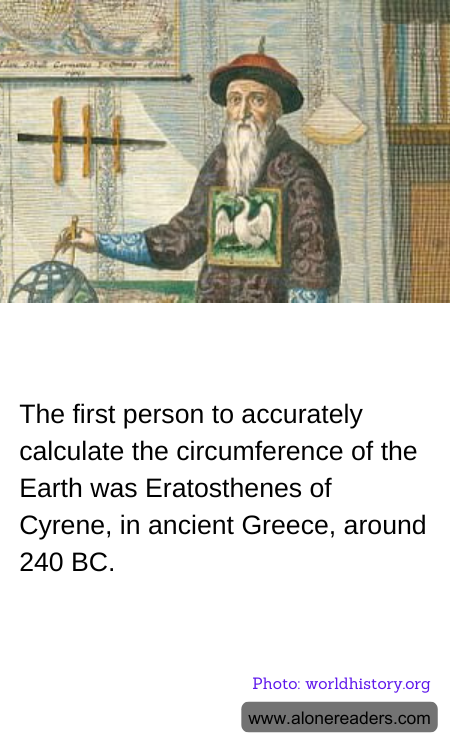
Eratosthenes of Cyrene, a Greek mathematician, geographer, poet, astronomer, and music theorist, made one of the earliest known accurate measurements of the Earth's circumference. Around 240 BC, based in Alexandria, then a major center of learning in the ancient world, Eratosthenes developed a method that demonstrated remarkable ingenuity and understanding of the Earth's geometry. His calculation stemmed from observing a phenomenon during the summer solstice in the city of Syene (modern-day Aswan, Egypt). At noon, the Sun was directly overhead, and no shadows were cast by vertical objects, as evidenced by the Sun shining directly down a deep well. Simultaneously, in Alexandria, shadows were indeed cast because the Sun was not directly overhead.
Eratosthenes employed a simple yet effective geometric analysis based on the differences in shadow angles at the two locations, which are approximately 800 kilometers apart from each other. By measuring the angle of the shadow in Alexandria (about 7.2 degrees), he was able to use geometry to calculate the circumference of the Earth. Given the angle he measured, he reasoned that this difference represented approximately 1/50th of a full circle (360 degrees), and thus estimated the Earth’s total circumference as about 50 times the distance between Alexandria and Syene—estimated at about 40,000 kilometers (25,000 miles), remarkably close to modern measurements.
What makes Eratosthenes' accomplishment all the more extraordinary is that he achieved this with the tools available during his time, without the benefit of modern equipment or technology. His approach not only proved that the Earth is spherical but also set a benchmark for scientific inquiry that integrates observational astronomy with mathematical precision. The methodology utilized by Eratosthenes laid foundational concepts that would later be advanced further by scientists during the Renaissance and beyond. His work is a testament to the innovative and inquisitive spirit of ancient Greek science, showcasing how theoretical knowledge combined with empirical investigation can yield results that stand the test of time.
