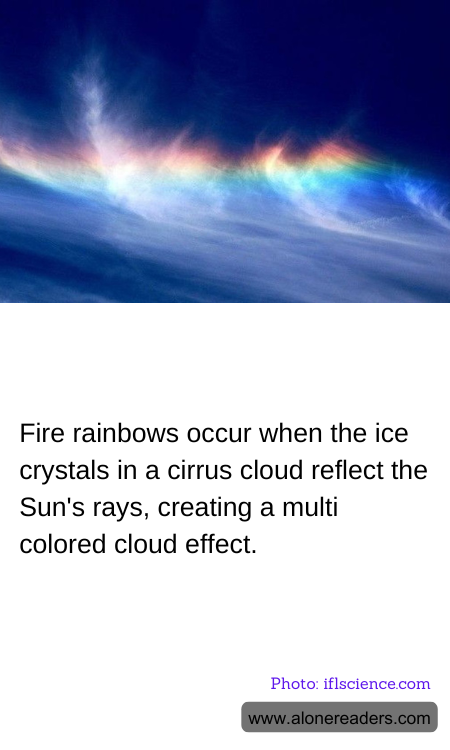
Fire rainbows, more accurately termed circumhorizontal arcs, are a mesmerizing natural phenomenon that occurs under specific atmospheric conditions. These arcs are not related to fire or rainbows in the traditional sense, but are so named because of their brilliant, flame-like colors and broad, horizontal appearance. This visual spectacle happens when the sunlight strikes high-altitude cirrus clouds—thin, wispy clouds that form above 20,000 feet and are made up of tiny ice crystals.
The circumhorizontal arc is formed when the Sun is very high in the sky, at an elevation of 58 degrees or greater. This typically occurs around midday during the summer months in the mid-latitudes. The sunlight must enter the ice crystals at a specific angle that allows the light to enter one of the crystal’s vertical faces and exit through a horizontal face. This process, known as refraction, splits the light into its spectral components, much like a prism would, resulting in a wide array of colors ranging from red to blue.
What makes the circumhorizontal arc distinctive is its broad, almost parallel bands of color, which can span across the sky under the right conditions. To see a fire rainbow, you must be positioned with the sun behind you and the cirrus clouds in front of you. These conditions limit their visibility to certain geographical locations and times of the year. For instance, in the United States, a fire rainbow is more likely to be seen in the higher latitude states during the summer, whereas closer to the equator, the sun reaches the necessary elevation more frequently.
Despite their rarity and the specific conditions required to view them, circumhorizontal arcs are among the most vivid and beautiful of atmospheric optical phenomena. When visible, they serve as a stunning reminder of the natural world’s ability to create extraordinary visions using just light and ice. The phenomenon doesn’t last long, generally fragmenting as the cirrus clouds shift or dissipate, which makes witnessing a fire rainbow an even more special and fleeting experience.
