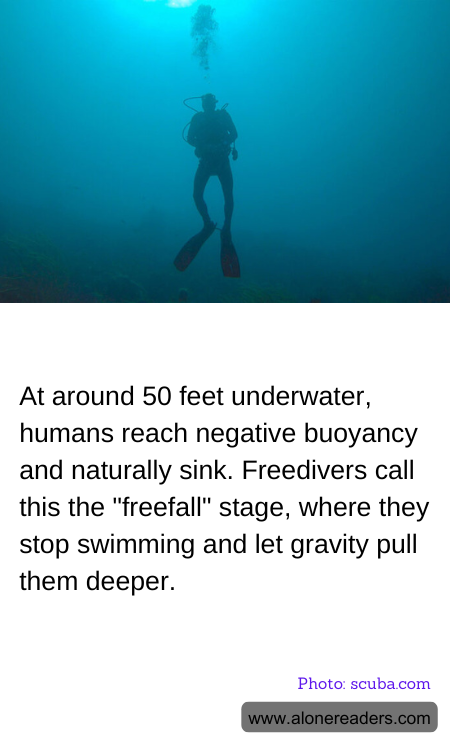
At a certain depth underwater, typically around 50 feet, human bodies undergo a remarkable transition known as negative buoyancy. This point, commonly referred to as "freefall" by freedivers, marks a shift where the body begins to sink naturally, without the need for continued swimming or propulsion. This phenomenon occurs due to the increasing water pressure at depth, which compresses the air in a diver's lungs and wetsuit, reducing their overall volume and thus their buoyancy.
For freedivers, reaching the freefall stage is a critical moment that is both challenging and exhilarating. Instead of actively swimming, divers at this stage relax their bodies and conserve energy by simply allowing gravity to pull them deeper into the ocean's embrace. This is not only a test of their physical skill in managing buoyancy and breath but also a profound mental challenge, requiring calm and focus amidst the enveloping pressure and darkness of greater depths.
The technique utilized during freefall is essential for depth disciplines in freediving. Mastery of this phase can significantly enhance a diver's efficiency, allowing them to reach greater depths without expending as much energy on active descent. Divers must be adept at managing their buoyancy through precise control of their lung volume and body position, ensuring that they neither sink too rapidly nor lose their descent momentum.
This intriguing aspect of freediving highlights the unique interplay between human physiology and the physics of underwater environments. It also underscores the importance of thorough training and knowledge for divers, ensuring that they can safely enjoy the profound peace and solitude offered by the world beneath the waves. Such experiences often lead to personal insights and a deeper appreciation for the ocean's mysterious depths.
