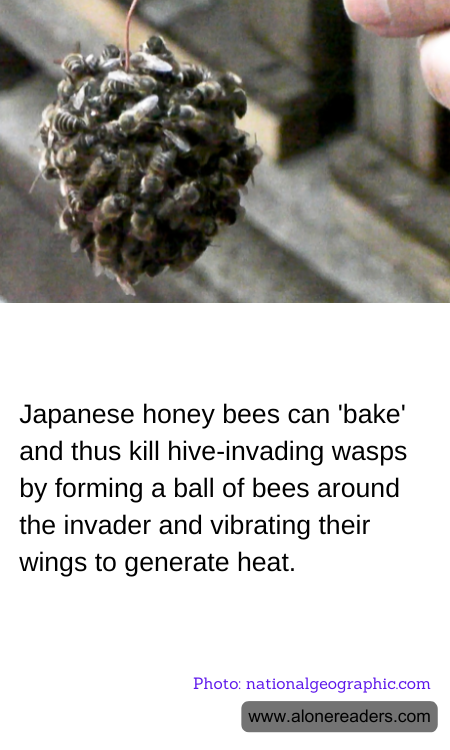
Japanese honey bees exhibit a fascinating and highly effective defense mechanism against their predators, notably the aggressive giant hornets. These hornets are much larger than the bees and can wreak havoc on bee colonies. However, Japanese honey bees have developed a unique strategy to counter attacks from these formidable foes.
When a hornet invader approaches the hive, it typically signals a grave threat as a single hornet can kill dozens of bees and is capable of destroying entire colonies to feed its own brethren. However, Japanese honey bees employ a tactic known as "heat balling" where they swarm around the intruder. The bees closest to the hornet clutch on and begin to vibrate their wing muscles vigorously. This concerted effort isn’t just a physical attack; it's an ingenious usage of thermal power.
The vibration increases the temperature at the core of the ball to a critical threshold that the bees can tolerate but is lethal to the hornet. This temperature can soar up to around 46 degrees Celsius (115 degrees Fahrenheit). The bees can survive temperatures up to 50 degrees Celsius (122 degrees Fahrenheit), but the hornets cannot withstand the intense heat generated by the bees' vibration and eventually die. This method not only allows the bees to kill the hornet but also acts as a deterrent against further invasion by other hornets.
This coordinated defense shows an incredible level of social cooperation and adaptability in Japanese honey bees. It highlights the evolutionary arms race between different species and the complex behaviors that can emerge as a result. This behavior, in extension, underscores the importance of each species in an ecosystem and the lengths to which they will go to protect their community and ensure survival. Such strategies are vital, especially for species like bees, whose role in pollination is crucial for the environment and agriculture globally.
