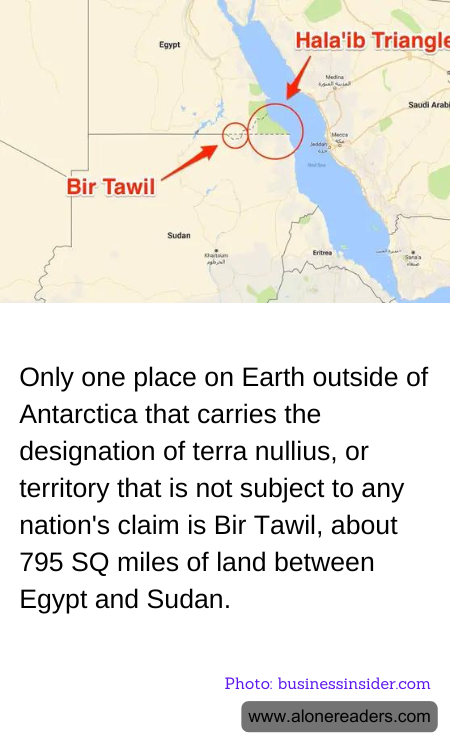
Nestled between the borders of Egypt and Sudan lies Bir Tawil, an intriguing expanse of land covering roughly 795 square miles, which stands as one of the most unique geopolitical anomalies on the planet. Bir Tawil is distinctive not just for its desolate landscape but also because it is considered terra nullius, meaning "no man's land." Unlike virtually every other patch of land on Earth, Bir Tawil is not claimed by any existing nation.
This unusual situation arises from a colonial-era boundary discrepancy dating back to the 19th century. In 1899, the Anglo-Egyptian Condominium established the political boundaries of the region, marking the 22nd parallel as the border. However, in 1902, a separate administrative boundary was drawn to reflect the ethnic makeup of local tribes. This resulted in two distinct boundaries: the administrative boundary giving control of Bir Tawil to the Sudanese, and the political boundary allocating it to Egypt.
Both Egypt and Sudan agree on the location of their shared border, but they base their claims on different maps. Sudan insists on the administrative borders which would give them the more agriculturally viable and larger area of Hala'ib Triangle, north of Bir Tawil, while Egypt relies on the political boundaries which would give them the same territory. As a result, each country claims the Hala’ib Triangle and disavows Bir Tawil, making it one of the last unclaimed pieces of land in the world.
Bir Tawil’s landscape is mostly desert, with mountainous areas in the north and no permanent residents. Its climate is harsh and inhospitable, which perhaps contributes to the lack of interest from both Egypt and Sudan in asserting sovereignty over the territory. Even though it lacks natural resources, the area has drawn the curiosity of adventurers and occasional claims by private individuals, often as a publicity stunt or a personal experiment in nation-building, though none of these claims are recognized by any government.
The case of Bir Tawil represents a rare footnote in the domain of international law and territorial politics, embodying a purely legal form of terra nullius. As countries typically rush to assert dominance over unclaimed lands rich in resources or of strategic importance, Bir Tawil remains a striking exception, overlooked and unwanted, yet a poignant reminder of the arbitrary nature of political borders and the complex legacy of colonial map-making.
