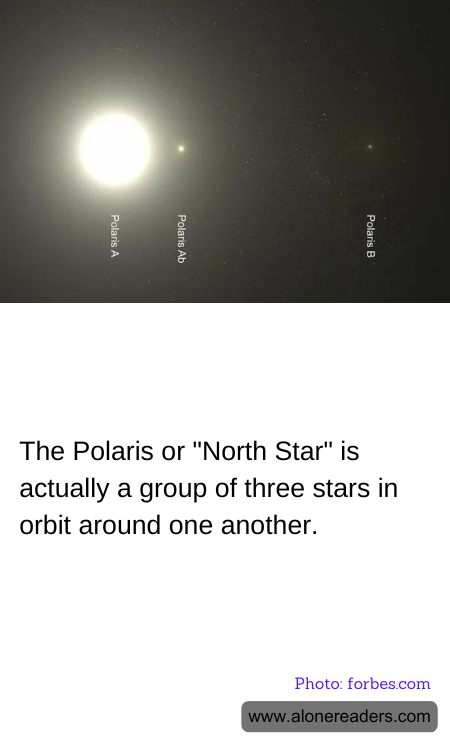
The Polaris, commonly known as the "North Star," has long been a beacon for navigators and astronomers, guiding explorers and serving as a pivotal point in the night sky. It is a widely recognized star largely due to its role as the current northern pole star, sitting almost directly above the North Pole, making it an excellent fixed point for celestial navigation in the Northern Hemisphere. However, a lesser-known fact about Polaris is that it is not a single star but a triple star system.
This stellar grouping consists of the primary star, Polaris A, and two smaller companions, Polaris B and Polaris Ab. Polaris A, the brightest of the three, is a supergiant star, categorised as an F7 type. It dominates the system with its significant luminosity, which is about 2,500 times that of the Sun. Researchers using the Hubble Space Telescope confirmed the presence of Polaris B, a smaller companion star, spotted some distance from Polaris A. Further deepening the complexity of this system, Polaris A itself was discovered to be a close binary system, with a very close companion Polaris Ab, a dwarf star. These findings indicate that what appears as a single point of light to the naked eye is actually a dynamic multiple-star system.
The orbits of these stars around each other also contribute something fascinating about their collective dynamics. The primary star, Polaris A, and its close companion Polaris Ab engage in a dance that astronomers have been able to observe with advanced telescopes. The orbital period of these two stars is relatively short, suggesting a close and interacting relationship.
Interestingly, the brightness of Polaris is not static. As a Cepheid variable, Polaris A exhibits changes in brightness with a regular period of just under 4 days. This variability is due to pulsations within the star itself, which have made Polaris an important object of study for understanding the distance scale of the universe.
In conclusion, Polaris is not just an iconic fixture in our night sky but also a complex and intriguing celestial phenomenon. Its composition as a triple star system adds a layer of complexity to our understanding of what might seem like just another single point of light in the sky. Its crucial role both historically and scientifically continues to make the Polaris system a subject of ongoing astronomical research and interest.
