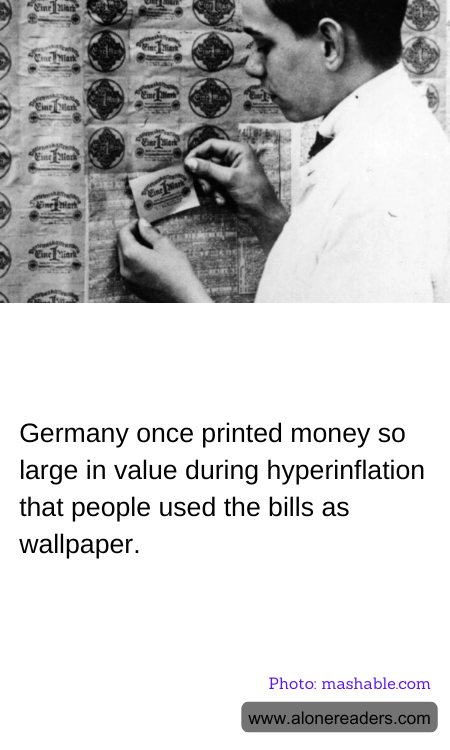
During the early 1920s, Germany experienced one of the most extreme cases of hyperinflation in recent history, an economic crisis that led to bizarre situations including, notably, the use of currency as wallpaper. The aftermath of World War I had left Germany in financial ruin. The Treaty of Versailles had imposed heavy reparations on the country, which it struggled to pay. In an attempt to meet these demands, the Weimar Republic began printing more money, which led to inflation. Initially mild, the situation soon spiraled out of control.
By 1923, the rate of inflation was astronomical, resulting in the issuance of banknotes with face values running into the billions and even trillions of marks. Currency value depreciated so rapidly that workers were paid twice a day, and the money would often become worthless within hours. The banknotes were so abundant and valueless that they were used for purposes other than commerce. People repurposed the printed notes in various ways due to the scarcity and high expense of regular goods under the crushing inflation. One of the most visual and often-cited examples of this was the use of banknotes as wallpaper. It was both an ironic statement and a practical choice, as the paper money was cheaper and more readily available than traditional wallpaper.
Photos from the era depict children playing with stacks of money like play blocks, and anecdotes tell of people wallpapering their homes with bills or using them to light stoves. This period is not merely a tale of economic mismanagement but also a visual commentary on the value of money and the absurd turns that economic crises can take.
The hyperinflation finally came to a halt when the government introduced the Rentenmark, a new currency backed by real estate, which helped to stabilize the German economy. However, the memories and impacts of this period remain a stark reminder of the potential consequences of unchecked monetary inflation and the importance of fiscal stability. The hyperinflation crisis of the Weimar Republic remains a key study point for economists and historians, illustrating how quickly the value of money can deteriorate and affect society in profound ways.
