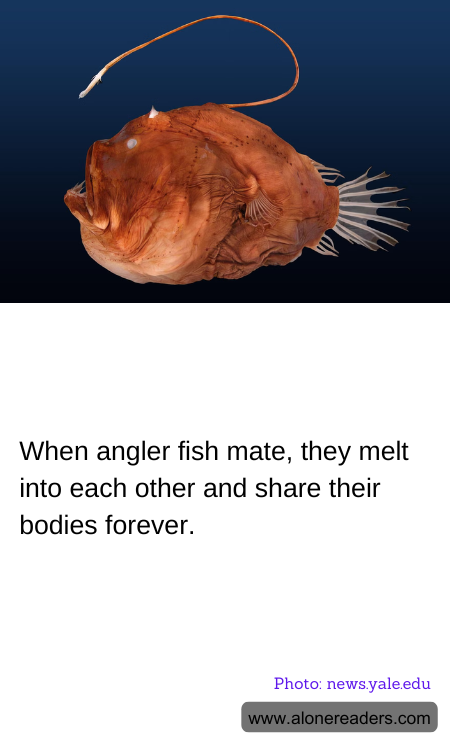
Deep in the abyss of the ocean, where light struggles to penetrate, the angler fish exemplifies one of nature's most bizarre and fascinating mating behaviors. This deep-sea creature, notorious for its menacing appearance and luminescent lure, engages in a mating process that is as eerie as it is captivating.
The process begins when the male, significantly smaller than the female, locates her in the vast darkness of the ocean depths. Due to the scarcity of mates in such an immense, dark environment, the male angler fish has evolved to have highly developed olfactory organs which allow him to detect the pheromones released by the female. Once he finds a potential mate, the male attaches himself to her body using his sharp teeth. This attachment is permanent; over time, the tissues of the male and the female fuse together, connecting their blood vessels, which allows the male to receive all his nutrition directly from the female’s bloodstream.
This extreme form of sexual parasitism is unique to angler fish. As the male loses his digestive organs, eyes, and most of his internal organs, he becomes entirely dependent on the female, existing solely as a sperm provider. From the moment of attachment and onward, the male’s body atrophies, leaving only the testes functional to fertilize the female’s eggs whenever she produces them.
The advantage of this extraordinary adaptation is that the female has ready access to a mate when needed, a significant benefit given the sparse distribution of life in the deep ocean. This ensures that whenever the female is ready to spawn, fertilization is guaranteed. The bond formed between the male and female angler fish is a literal melding of bodies and a life-long commitment, dictated purely by the necessity to survive and reproduce in the challenging environments of the deep sea.
This remarkable reproductive strategy highlights not only the diversity but also the extremity of life adaptations. The angler fish’s survival strategy provides a vivid example of the lengths to which evolution can go in ensuring the continuation of a species under harsh conditions.
