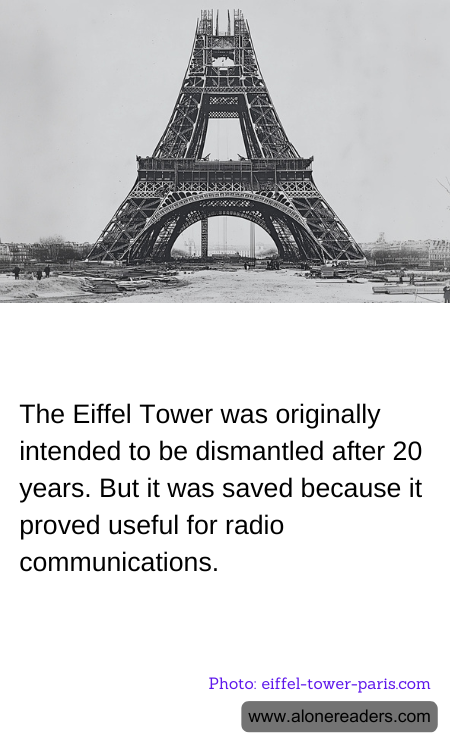
When the Eiffel Tower was constructed for the 1889 Exposition Universelle (World's Fair) in Paris, it was not intended to remain as a permanent fixture. The icon, designed by French engineer Gustave Eiffel, was originally slated for dismantling in 1909, a mere 20 years after its inauguration. Its fate, however, took a turn due to the evolution of telecommunications technology which found a valuable asset in the tower's formidable height.
The Eiffel Tower stood as the world's tallest man-made structure until the completion of the Chrysler Building in New York in 1930. Its height was instrumental as radio technology began to emerge at the turn of the century. The military potential of the tower was realized when it was used as a radiotelegraph station. This transition began during the First World War, where its vantage point allowed for effective jamming of German radio communications, crucial to the war effort. This strategic use imparted a new lease on life for the Eiffel Tower, marking it as an invaluable tool for security and communication, rather than merely an artistic or architectural endeavor.
Post-war, its utility expanded into the realm of public radio broadcasting. By the mid-20th century, television transmissions also began to emanate from the Eiffel Tower. Its role in media transmission solidified its status as a permanent fixture in the Parisian landscape. More than just a marvel of industrial age engineering and a symbol of modernity, the Eiffel Tower became a critical link in the communication networks that were becoming increasingly pivotal globally.
Today, the Eiffel Tower is not only a symbol of French innovation and artistry but also a reminder of how technological evolution can extend the utility of structures beyond their original intent. From a temporary exhibit to a vital communications hub, the Eiffel Tower’s saga reflects the dynamic interplay of art, technology, and history, making it one of the most recognized and cherished landmarks in the world. It serves as a testament to the unforeseen virtues that can emerge from the integration of technological advancements with structural design. Thus, the Eiffel Tower remains a beacon of human achievement across multiple fields.
