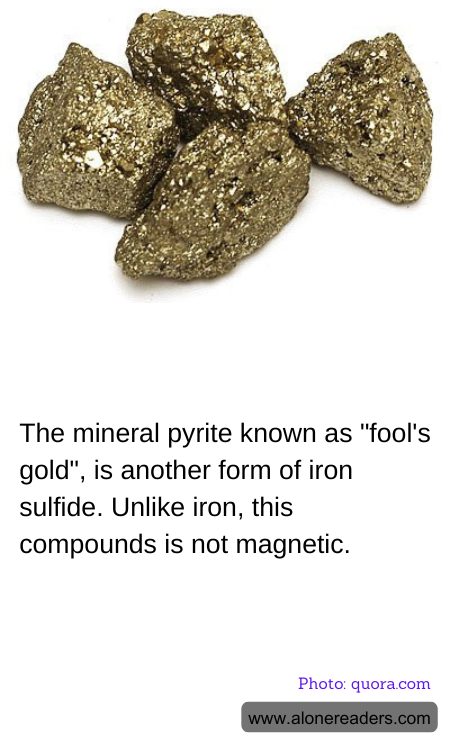
Pyrite, often called "fool's gold" for its misleading shiny golden hue, is an iron sulfide mineral with a chemical composition of FeS2. It differs from real gold not only in composition but also in properties such as magnetism and density. Pyrite forms when iron and sulfur combine in reducing environments such as sedimentary rocks and hydrothermal veins.
One interesting feature of pyrite is that, contrary to popular belief, it is not magnetic. This non-magnetic property sets it apart from many other iron-containing minerals. The confusion often arises because iron, which is a major component of pyrite, is typically magnetic in its pure metallic form. However, when iron is combined with sulfur to form FeS2, the resulting molecular structure does not inherit the magnetic properties of elemental iron.
Pyrite's crystal structure is another notable attribute; it crystallizes in the isometric system, typically forming cubes, pyritohedrons, or sometimes octahedral shapes. These well-formed, shiny crystals can catch the eye of miners and gem collectors, who might initially mistake them for gold due to their metallic luster and pale brass-yellow hue. However, unlike gold, which is malleable and ductile, pyrite is brittle and will shatter when struck with a hard object.
While it may be a disappointment for those panning for gold, pyrite has significant value in various industrial applications. Historically, it was used to produce sulfuric acid and, in some cases, to assist in the paper making process. Its role in modern industries includes use as a source of sulfur dioxide in the manufacture of paper, and sometimes as a cathode material in lithium batteries.
Moreover, pyrite is crucial for researchers in environmental science, where its tendency to form acid mine drainage upon exposure to water and oxygen is studied to prevent and mitigate environmental pollution. This characteristic can lead to significant ecological challenges around mining areas, affecting water pH and metal concentrations in nearby streams and rivers. Pyrite's presence, therefore, must be carefully managed in mining operations to avoid environmental contamination.
Despite its deceptive appearance and the initial disappointment it might cause, pyrite remains a fascinating mineral with important applications and implications in various fields of work and study. Its distinct characteristics like non-magnetism, susceptibility to acid drainage formation, and historical role in industrial processes make it a subject of interest well beyond its visual similarity to gold.
