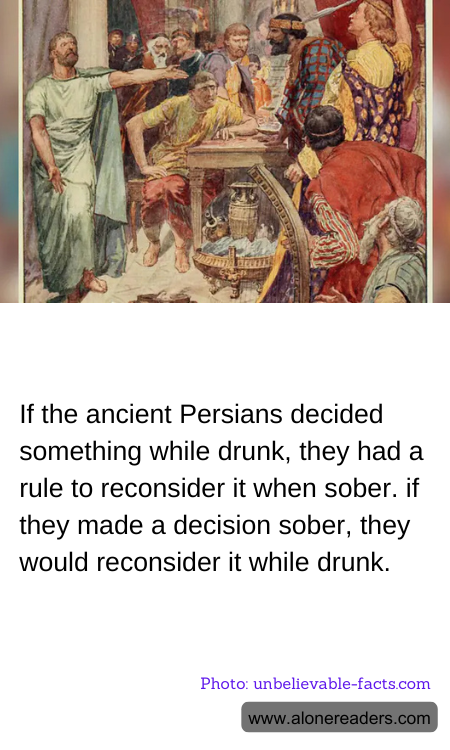
The ancient Persians, renowned for their vast empire and sophisticated culture, held a unique approach to decision-making that intertwined sobriety with intoxication. This practice was deeply embedded in their societal and governmental structures, and it underscores the importance they placed on thorough and comprehensive deliberation in their decision-making processes.
According to historical accounts, most notably by the Greek historian Herodotus, the Persians believed that to reach the most effective and holistic decision, it was essential to evaluate the matter under two completely different states of mind: once while drunk and once while sober. This practice stemmed from the belief that the true nature of their choices could only be revealed by examining them from all possible perspectives, ensuring a balance between emotion and reason, impulse and reflection.
When the Persians convened to discuss significant issues, they would indulge in copious amounts of wine during their initial deliberations. This environment, less inhibited and more emotionally driven, was thought to foster creativity and the free expression of thoughts and feelings that might be repressed in more formal, sober circumstances. Drunkenness was seen not as a deterrent to serious thought but as a catalyst for stripping away pretenses and getting to the heart of matters.
However, aware of the reckless decisions that might arise from such an uninhibited state, they implemented a safeguard: revisiting the decision once sober. In this second round of deliberation, they could reassess their earlier judgments with a clear mind, applying logical and practical scrutiny. If the decision made while intoxicated still held up under the sobriety test, it would be considered sound and implemented. Conversely, if sober scrutiny presented too many flaws in the plan, it was discarded or revised.
This dual scrutiny method ensured that both the emotional intuitiveness and the rational pragmatism of the leaders were given voices in their governance, reflecting a profound understanding of human psychology—long before it became a formal science. This approach might even offer valuable lessons in modern settings where balancing heartfelt intuition with rational thought remains as relevant as ever. By embracing the full spectrum of human faculties, the ancient Persians championed a holistic approach to governance that could navigate the complexities inherent in ruling an empire as diverse and expansive as theirs.
