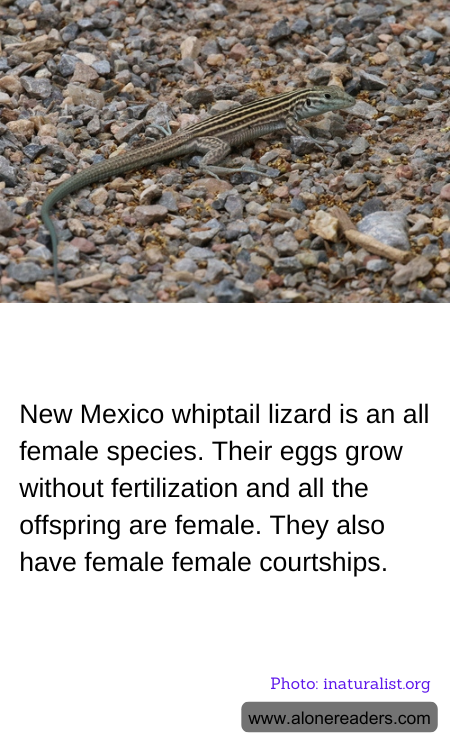
The New Mexico whiptail lizard (Aspidoscelis neomexicanus) is a fascinating example of a unisexual species, where the population is entirely female. Unique among reptiles, these lizards exhibit a form of reproduction known as parthenogenesis, wherein their eggs develop into viable offspring without the need for fertilization by male sperm. This means that each individual lizard is essentially a clone of its mother, perpetuating an all-female lineage.
Found primarily in the southwestern United States, specifically in New Mexico and parts of Arizona, the New Mexico whiptail is the result of a hybridization between two other species of lizards: the little striped whiptail and the western whiptail. This hybridization event has endowed the New Mexico whiptail with a fascinating genetic makeup and adaptive capabilities that allow it to thrive in its arid and semi-arid habitats.
Despite being an all-female species, New Mexico whiptail lizards engage in behaviors typically associated with mating and courtship. Female-female courtships are common, where one lizard assumes the role typically played by the male. This behavior, known as pseudocopulation, is thought to stimulate ovulation and encourage the reproductive process, although the exact reasons and mechanics behind this behavior are still being studied.
The reproduction strategy of the New Mexico whiptail presents certain evolutionary advantages and disadvantages. On one hand, parthenogenesis allows for rapid population growth and can be beneficial in stable environments where adaptation to changing conditions is less critical. On the other hand, sexual reproduction, by combining the genes of two individuals, typically fosters greater genetic diversity and adaptability. The New Mexico whiptail compensates for the lack of genetic diversity somewhat through mutations and the occasional incorporation of genetic material from related species, a process facilitated by their hybrid origins.
Conservationists and biologists continue to study the New Mexico whiptail not only to understand its unique reproductive biology but also to gauge its responses to environmental pressures and changes. Such research helps illuminate the complex interplay between genetics, behavior, and environment in the evolutionary trajectories of species. The New Mexico whiptail is indeed an extraordinary example of nature’s boundless adaptability and serves as a captivating subject in the study of evolutionary biology.
