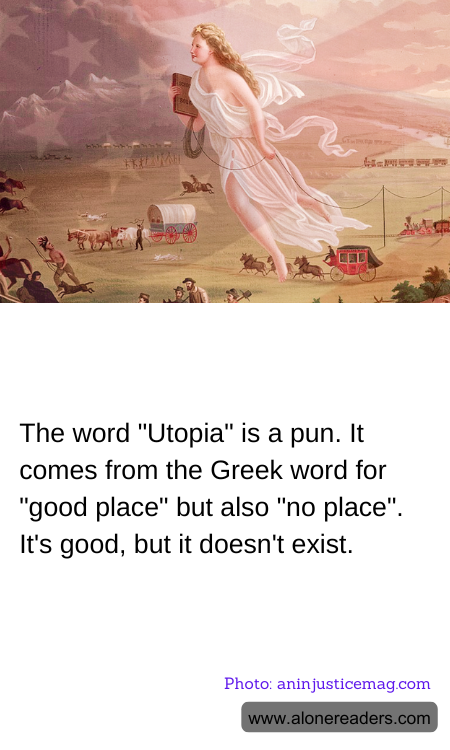
The concept of utopia is a fascinating blend of hope and imagination, grounded in the dual meaning of its name derived from Greek. The word "utopia" cleverly amalgamates "eutopia," which translates to "good place," and "outopia," meaning "no place." This linguistic playfulness encapsulates the essence of utopian thinking—envisioning an ideal society that is profoundly desirable yet simultaneously unattainable.
Thomas More, an English philosopher and author, first coined the term in his 1516 book titled "Utopia." In this work, More describes a complex, self-contained community set on an island, where people share a common way of life and everything is in communal ownership. The societal blueprint laid out in More’s "Utopia" reflects his aspirations for an egalitarian society while acknowledging the challenges and improbabilities of such a perfection in reality.
Ever since More’s depiction, the notion of utopia has become a significant cultural and philosophical touchstone. It has inspired countless works of fiction, propelled political ideologies and movements, and sparked debate over what constitutes an ideal society. Utopian thinking encourages a critical examination of existing social, political, and economic conditions, while also pushing the boundaries of what could be possible in human organization.
Importantly, the inherent contradiction within the term "utopia" provides a built-in critique of utopian ideals—highlighting that while striving for a "good place" is noble, such a place might ultimately be "no place" in reality. This duality serves as a reminder of the limitations of human efforts but also underscores the importance of continual striving for betterment.
In contemporary discourse, the concept of utopia has evolved. It oscillates between being an unreachable, idealized vision and a practical framework informing progressive change. As global challenges like inequality, environmental degradation, and political divisiveness intensify, the utopian vision offers a lens through which to rethink solutions and aspire toward a more harmonious and sustainable existence. Thus, while a true utopia might remain a paradox, the journey toward it continues to inspire and propel human society forward.
