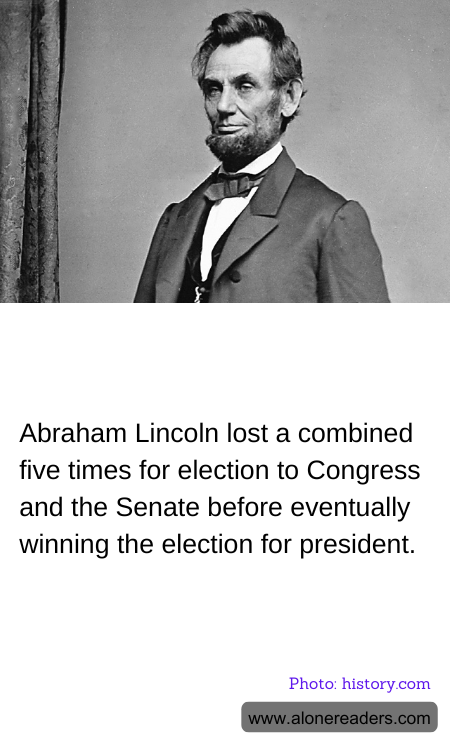
Abraham Lincoln's political journey was marked by resilience and enduring commitment to his principles, despite repeated electoral defeats. Before his historic election as the 16th President of the United States in 1860, Lincoln faced multiple setbacks that might have discouraged a less determined individual. His political career began modestly in the Illinois State Legislature, where he served four consecutive terms. Despite this initial success, Lincoln's attempts to scale the federal political ladder were fraught with challenges.
Lincoln first sought a seat in the United States House of Representatives in 1843 but was unsuccessful. He managed to secure a term in Congress in 1846, representing Illinois, but his tenure did not lead to further immediate national political opportunities. Undeterred, Lincoln set his sights on the U.S. Senate. The mid-19th century process for electing senators — which was conducted by state legislatures rather than by direct vote — added an additional layer of complexity to his ambitions.
In 1854, Lincoln ran for the Senate but lost. He tried again in 1858, engaging in what would become the historic Lincoln-Douglas debates with Senator Stephen A. Douglas. These debates made Lincoln a prominent national figure and showcased his eloquence and firm moral stance against slavery, despite his loss in the election. Again, in 1859, Lincoln’s candidacy for the Senate was unsuccessful. Each defeat, however, offered him crucial public exposure and helped refine his political arguments, particularly concerning the issue of slavery and the expansion of it into new territories.
Lincoln’s resilience was finally rewarded in the presidential election of 1860. Leveraging his growing reputation from the debates and his strong stance on national issues, Lincoln was nominated by the Republican Party. His platform appealed to a broad coalition of anti-slavery and modernizing interests. In a fractured political climate exacerbated by sectional tensions over slavery, Lincoln won the presidency without carrying a single Southern state.
His presidency, marked by the Civil War and the emancipation of slaves, validated the perseverance he showed throughout his earlier political defeats. Lincoln's story is a testament to the impact of steadfastness and integrity in the face of repeated setbacks. His earlier electoral losses, far from ending his political career, were stepping stones that ultimately prepared him for leadership during one of America's most pivotal epochs.
