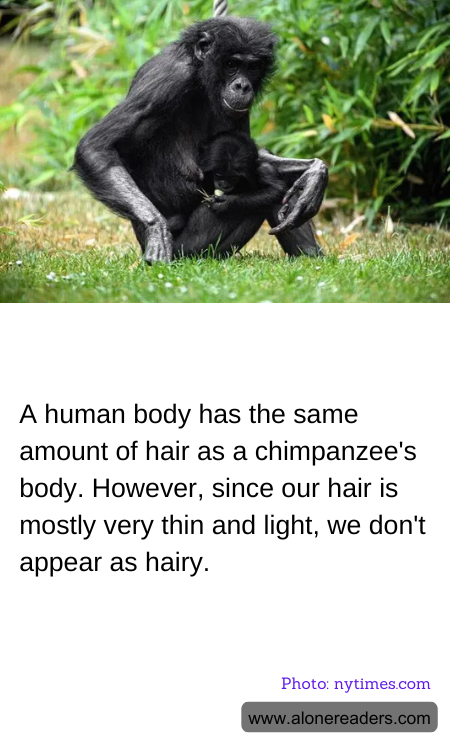
Despite appearances, the human body has about the same number of hair follicles as a chimpanzee’s body. This might be surprising given the stark contrast in the hairiness between the two. The key difference lies not in the quantity of the hair follicles but in the type of hair that grows from them. In humans, much of the body hair is vellus hair, which is finer and lighter than the thicker, darker terminal hair that covers the bodies of our primate cousins.
Vellus hair is virtually invisible to the naked eye, contributing to the perception that humans are less hairy. This type of hair develops during childhood and covers much of the human body, providing functions such as temperature regulation and evaporation of perspiration. In contrast, terminal hair, which also appears on human heads, underarms, and pubic regions upon reaching puberty, is coarser and much more visible.
The evolutionary pathway that led humans to have more vellus hair and less terminal hair is widely discussed among scientists. One prevailing theory suggests that as humans evolved and migrated out of Africa, less body hair and more sweat glands helped with heat dissipation in open, hot environments. This adaptation made it easier for early humans to hunt and travel during the day over long distances without overheating.
Interestingly, the density of hair follicles in humans is consistent across different skin colors and genders, implying a uniform evolutionary pattern. However, genetic and hormonal factors influence the thickness and visibility of hair, which can vary widely from one individual to another. Conditions such as hirsutism in women and baldness in men demonstrate how these factors can govern hair growth beyond the evolutionary blueprint provided by our shared ancestry with chimpanzees.
Ultimately, while humans may look less hairy, our skin tells a story of adaptation and survival that is more complex than the simple presence of hair. By maintaining the same number of follicles but altering the type of hair, humans have evolved to balance the body’s needs against environmental challenges, a testament to the intricate and dynamic nature of evolutionary biology.
