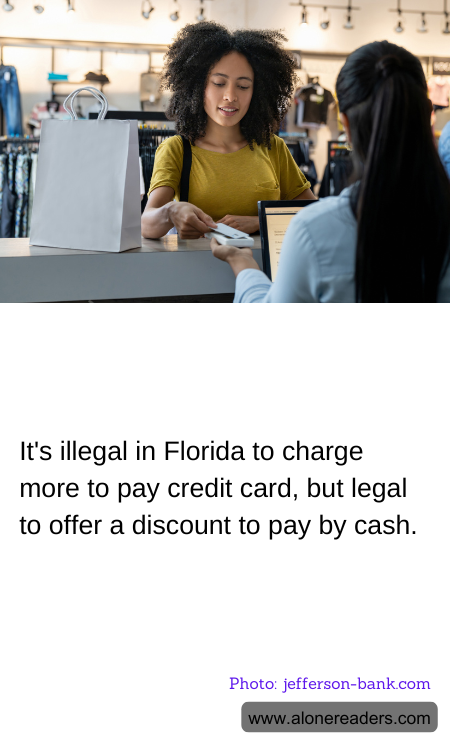
In Florida, the laws regarding payment methods offer a curious paradox that affects both businesses and consumers. The state prohibits charging credit card users a higher amount than those paying by cash, which is considered a surcharge. However, it permits the practice of providing a discount to customers who pay in cash. This subtle legal distinction allows merchants to incentivize cash transactions without explicitly penalizing those who choose to pay with credit cards.
The rationale behind this regulation is tied to the fees associated with credit card transactions, which merchants must pay to banks and credit card companies. These fees can significantly impact the net revenue of small businesses. By offering discounts to cash payers, merchants can effectively avoid these fees while passing some savings onto the customers. Moreover, this approach is also perceived to encourage cash transactions, which can be simpler to manage compared to processing credit cards.
Yet, this rule creates a need for careful communication to avoid consumer confusion or mistrust. Businesses must clearly denote these discounts as cash discounts rather than framing them as penalties for using credit cards. Misrepresentation can lead to consumer dissatisfaction and potential legal troubles, as it might be viewed as going against the no-surcharge rule by disguising extra charges in misleading terms.
Consumers, on the other hand, benefit from the possibility of saving money when paying by cash. This can be particularly advantageous for those who wish to avoid accruing credit card debt or for whom privacy in transactions is a priority. Moreover, for those without access to credit cards, cash discounts can make essential goods and services more affordable.
Overall, Florida's distinction between credit card surcharges and cash payment discounts highlights a complex balance between consumer protection and business rights. It underscores a broader dialogue on the costs and benefits of different payment methods in an increasingly digital economy. As such, both consumers and businesses must stay informed about these regulations to make choices that align with their financial and operational preferences.
