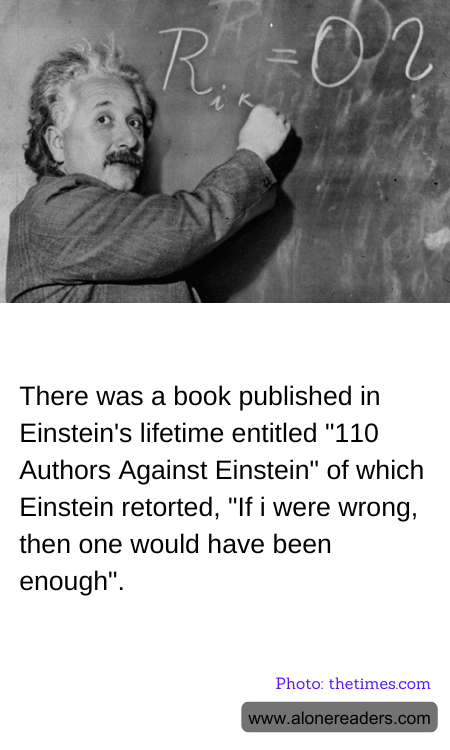
The anecdote related to Albert Einstein and his exchange regarding the book titled "110 Authors Against Einstein" encapsulates the essence of intellectual defiance and the power of a robust scientific argument. The book was published in 1931 in Germany, and its primary thrust was to contest and criticize Einstein’s theory of relativity, a groundbreaking and, at times, contentious framework that had redefined contemporary understandings of time and space. The book included essays and papers from a variety of scientists and philosophers, each outlining their objections and challenges to aspects of Einstein’s theories.
Einstein's pithy retort, "If I were wrong, then one would have been enough," underscores an essential aspect of scientific discourse: the quality of an argument carries more weight than the quantity of people who support it. This response from Einstein emphasizes the notion that in science, no amount of consensus can overturn a fact; it takes only one correct and well-substantiated argument to disprove a theory.
This scenario is not just about Einstein defending his groundbreaking theory against a legion of critics, but also highlights his belief in logical, empirical scrutiny over popularity or common sentiment in scientific debates. It reflects his confidence in the integrity of his findings and also illustrates a broader epistemological point: in the pursuit of truth, what ultimately matters is not how many people say something is wrong, but whether their corrections are based on solid evidence and logically sound arguments.
Furthermore, this exchange illustrates the resilience required in the face of widespread skepticism and criticism in the scientific community. Einstein’s theories, particularly the theory of general relativity introduced in 1915, were revolutionary at that time and naturally met with opposition. Over the years, the empirical validations of his theories, including the famous 1919 solar eclipse observation that supported his predictions about light bending around the sun, gradually silenced most critics by demonstrating the accuracy of his insights.
This incident remains a noteworthy element in the legacy of Einstein not just for its witty comeback but also for its profound implications about the nature of scientific truth and the ethos of intellectual debate. It serves as a reminder that in science, the pursuit of knowledge is often a contentious and challenging journey, where evidence must continually be scrutinized and claims robustly defended.
