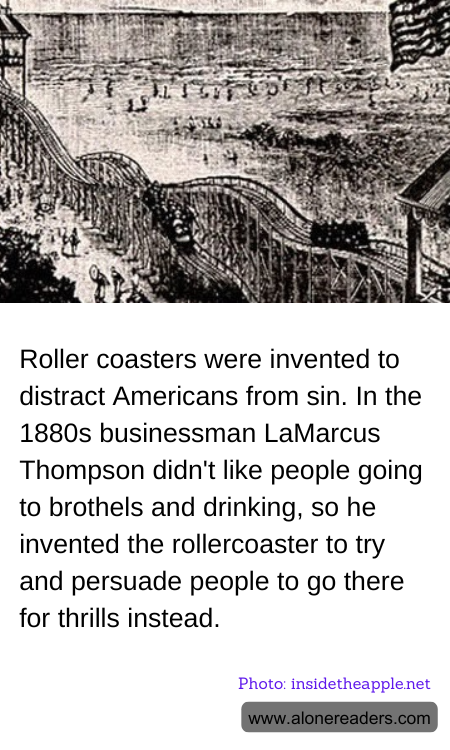
The invention of the roller coaster is indeed intertwined with an interesting cultural objective, particularly in the United States during the late 19th century. LaMarcus Adna Thompson, known as the "Father of Gravity," was pivotal in this development. Thompson was a deeply religious man who was reportedly dismayed by what he saw as the sinful behaviors of his time, notably in places of ill-repute such as saloons and brothels. In 1884, Thompson constructed what is considered one of the earliest roller coasters at Coney Island, New York. His invention was not just an engineering feat but also had a moral dimension.
Thompson's Switchback Railway, while primitive by modern standards, was an instant success. It was conceived as a wholesome entertainment alternative to more debauched pastimes, offering fun and excitement without the moral compromise. This ride involved passengers sitting in a bench-like car and being pushed up to the top of a track, which they would then roll down by gravity to the opposite end. The structure was simple and the speeds were not very high, but the concept of using gravity for entertainment caught on quickly and spread across the country.
Thompson’s innovation resonated with the values of the middle class, effectively offering a "healthy" distraction from the vices seen as prevalent among society’s poorer sections. It's intriguing to observe how Thompson’s moral intent dovetailed with his business acumen. As more middle-class families began seeking leisure activities that were aligned with their values, roller coasters and amusement parks began to be seen as family-friendly venues promoting wholesome fun.
The growth of roller coasters and amusement parks in America can be seen as part of a larger cultural shift towards organized recreational activities during this time, ones that were accessible to the broader public and deemed socially acceptable. Over time, the technology and safety of roller coasters improved, designs became more complex, and their popularity only soared. Despite the thrill and excitement associated with modern roller coasters, the origins of this amusement ride are rooted in a desire to offer alternative entertainment to activities considered undesirable.
Thus, the roller coaster's history is a fascinating example of how cultural, moral, and technological elements can intersect, producing innovations that last well beyond the lifetime and initial intentions of their creators. Thompson might have been motivated by moral concerns, but in doing so, he inadvertently laid the foundation for a global industry dedicated to the simple thrill of riding the rails.
