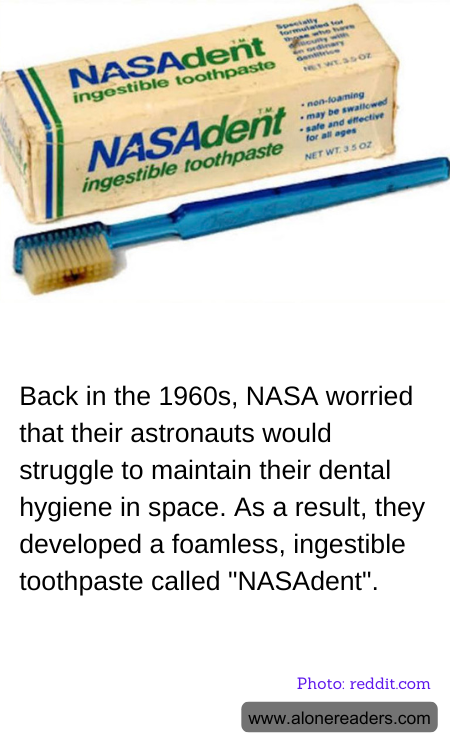
In the early days of space exploration, NASA faced numerous challenges, one of them being the dental hygiene of astronauts during extended missions. The weightlessness in space posed a unique challenge for everyday activities, including brushing teeth. Traditional toothpaste, which requires spitting and rinsing, was impractical in the zero-gravity environment. In response to this, NASA scientists developed an innovative solution called "NASAdent" during the 1960s.
NASAdent was a foamless and ingestible toothpaste, designed specifically for use in space. Traditional toothpaste would create foam, which could be disruptive and potentially dangerous in a spacecraft, as floating blobs of toothpaste foam could damage equipment or be inadvertently inhaled by the crew. The solution was a toothpaste that could be swallowed safely, eliminating the need to spit it out after brushing.
This toothpaste was made from edible ingredients that would not harm the astronaut if ingested. This not only solved the issue of disposing of toothpaste foam in space but also helped in maintaining the oral health of astronauts who could continue to brush their teeth just as they would on Earth. The development of NASAdent is a prime example of the sort of innovative solutions necessary for dealing with the unique conditions of space travel.
Over the years, technology in space has advanced, and the approaches to dental hygiene have evolved. Today, astronauts use a toothpaste similar to what we use on Earth but have to swallow the saliva-toothpaste mix or spit it into a towel. Although NASAdent was a product of its time and is no longer used, it marked an important step in adapting human needs to the space environment, laying groundwork for the more sophisticated solutions we see today in various aspects of space habitation.
