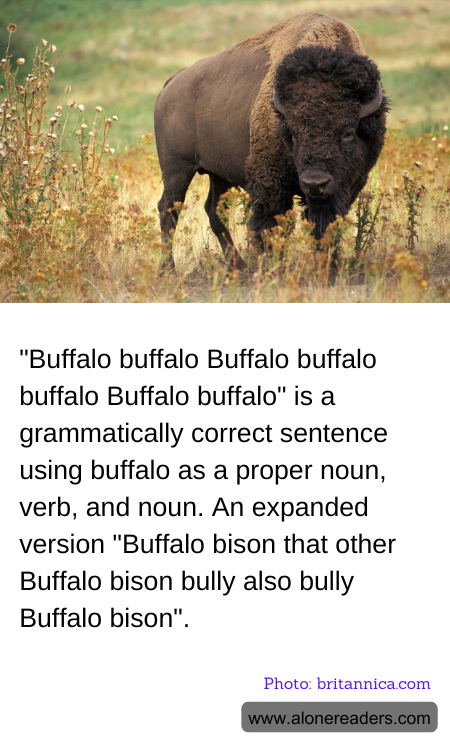
The sentence "Buffalo buffalo Buffalo buffalo buffalo Buffalo buffalo" is a classic example of how homonyms and homophones can be used to create complex, linguistically valid sentences. In this sentence, the word "buffalo" is used as a proper noun, verb, and noun, showcasing the flexibility and depth of English syntax and morphology.
Breaking it down, the first "Buffalo" refers to the city of Buffalo in New York. The second and third uses refer to the animal, bison, commonly referred to as buffalo. Finally, the verb "buffalo," which means to bully or intimidate, explains the action occurring among these bison. When expanded, the meaning of the sentence becomes clearer. It essentially says, "Buffalo bison [that other Buffalo bison bully] also bully [Buffalo bison]."
This type of sentence, known as a recursive sentence, illustrates how grammar structures in English can be nested within each other. Such sentences play with linguistic recursion, allowing an indefinite number of ideas to be inserted into the sentence through clauses, maintaining grammatical correctness regardless of length.
The fascination with this sentence goes beyond its complexity or the amusement of its puzzling nature. It serves as an educational tool for linguists and language learners by highlighting aspects of English syntax and the roles that context and punctuation play in understanding. Additionally, it points out the rich meanings that can arise from homonymic and homophonic usage in English, offering insights into sentence construction and interpretation that are foundational in linguistic studies. In practical terms, while such sentences are rare in everyday communication, they stimulate discussions on grammar and usage, proving that language structure is not just about rules but also about creativity and the inherent flexibility in human communication.
