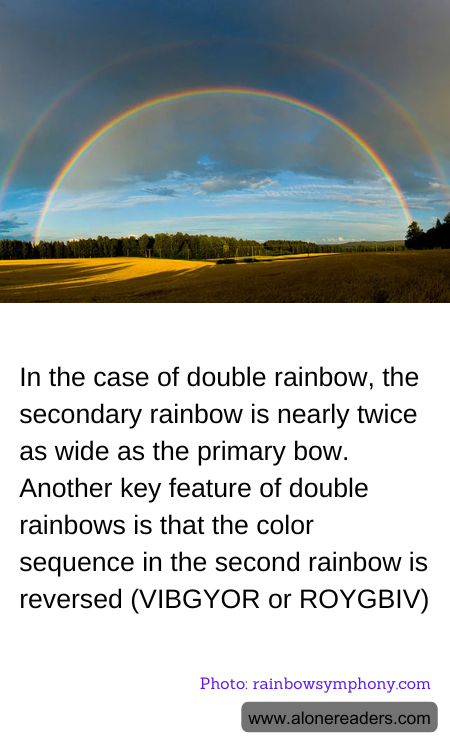
A double rainbow, a captivating phenomenon in the natural world, occurs when light is reflected twice inside water droplets in the atmosphere, producing two concentric circular arcs. The primary rainbow, which is brighter and more commonly observed, forms at an angle of about 42 degrees to the line from the sun to the observer's back. The secondary rainbow, appearing outside the primary, is the result of two reflections within the droplet and is visible at about 50 to 53 degrees from the same line.
One of the most striking differences between the two rainbows, aside from the brightness, is their color order. In the primary rainbow, colors are arranged from red on the outer edge to violet on the inner edge, following the typical ROYGBIV (red, orange, yellow, green, blue, indigo, violet) sequence. Conversely, the secondary rainbow displays these colors in reverse order. Here, red is on the inner side and violet on the outer, a sequence referred to as VIBGYOR. This inversion occurs because the light is reflected twice inside the water droplets, reversing the spectrum.
Moreover, the secondary rainbow is typically about twice as wide as the primary rainbow. This additional width and the paler colors of the secondary rainbow are due to more light being lost with each reflection within the droplets and the greater spread of angles over which the observer sees the light. These features make the secondary rainbow not only fainter but also broader compared to its more vivid counterpart.
Observers lucky enough to witness a double rainbow often remark on its beauty and the ethereal quality of seeing twin multicolored circular arcs in the sky. This natural spectacle not only provides a stunning visual but also a compelling demonstration of the optics of light and water in the atmosphere.
