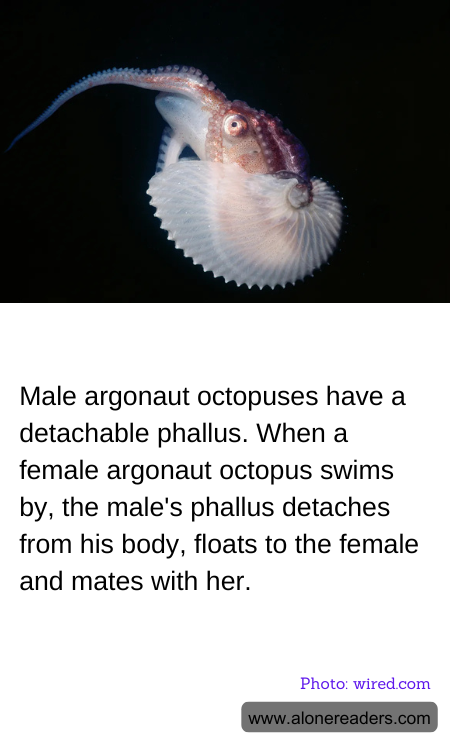
The reproductive habits of the argonaut, or paper nautilus, throw an intriguing light on the diverse evolution of marine life, particularly among cephalopods. The argonauts are unique among octopuses, with the males possessing an extraordinary adaptation: a detachable phallus known as the hectocotylus. This remarkable adaptation allows the male to mate in a manner unlike most other species in the animal kingdom.
In the dynamic and often perilous ocean environment, direct mating can be risky and energetically expensive. Hence, the male argonaut has evolved a solution that maximizes his chances of reproductive success while minimizing personal risk. During mating, the hectocotylus, which holds the sperm, detaches from the male's body and becomes an autonomous entity. Once detached, this specialized arm swims towards the female, guided by chemotactic signals.
When the detached hectocotylus reaches the female, it will secure itself onto her mantle cavity, the site of fertilization. This process allows the male to effectively impregnate the female with a minimal physical encounter. For the male argonaut, this means the ability to potentially mate with multiple females from a distance, thereby spreading his genes widely without the typical exertions or dangers associated with direct mating encounters.
Interestingly, after detachment, the male can regenerate a new hectocotylus, allowing for multiple mating opportunities throughout his lifetime. This peculiar form of reproduction not only highlights the male's role as solely procreative but also underscores the female's dominant role in the mobility and defense of the duo.
The females, on the other hand, provide protection for the eggs. They create a unique casing or shell - called the paper nautilus - which serves as a brooding chamber, distinctively crafted from a secretion produced by their tentacles. This not only helps in safeguarding their offspring but also aids in managing buoyancy in water.
This fascinating reproductive strategy of the argonauts emphasizes the adaptive mechanisms developed by marine creatures to cope with the demands and risks of oceanic life. The detachable hectocotylus of the argonaut not only provides a curious case study in the field of biological adaptation but also illustrates the incredible diversity of life and the myriad ways in which it reproduces and survives in various environments. Such mechanisms remind us of the complexity and wonder of marine life, urging further study and conservation efforts to protect these remarkable creatures and their habitats.
