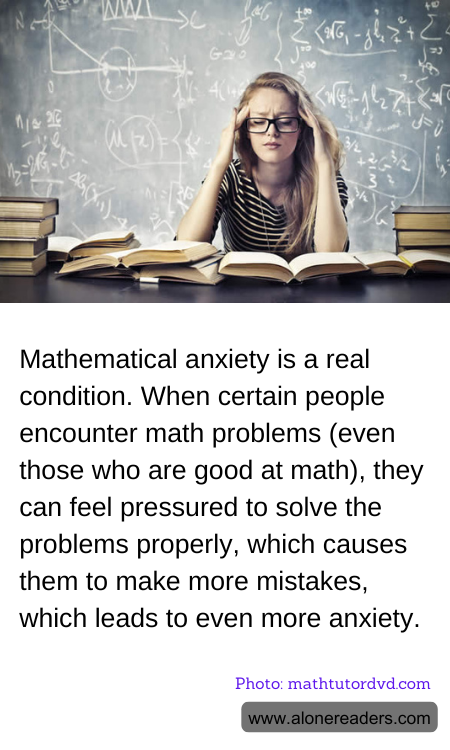
Mathematical anxiety, or math anxiety, is a psychological phenomenon that affects individuals across various skill levels in mathematics. It involves a feeling of tension, apprehension, or fear that significantly interferes with one's ability to perform math tasks. This condition highlights an interesting paradox: even those who are proficient in math can experience such anxiety, which in turn affects their performance adversely.
The origins of math anxiety can be traced to several factors. Educational environments play a crucial role, as early experiences with teaching methods that do not accommodate individual learning paces or styles can contribute to a lasting fear of the subject. Negative feedback, high-stakes testing, and a general cultural mindset that views math as inherently difficult also compound this anxiety.
When faced with math problems, individuals with math anxiety may experience a variety of symptoms including a racing heart, sweaty palms, and even a panic response, mirroring symptoms of more generalized anxiety disorders. These physiological responses can cloud cognitive functions, making it harder to recall mathematical concepts learned and to apply reasoning skills effectively.
Interestingly, the pressure to perform well can initiate a frustrating cycle: anxiety leads to errors, which in turn increase anxiety in future mathematical endeavors, eroding self-confidence. Research suggests that this might be due to the way anxiety uses up working memory that is crucial for carrying out complex calculations. When the brain's cognitive resources are directed towards managing feelings of anxiety, fewer resources are available for solving math problems.
Combating math anxiety involves a multipronged approach. Teaching strategies that foster a growth mindset, emphasizing that abilities in math can be developed through effort and learning from mistakes, have shown effectiveness. Interventions such as anxiety-reduction techniques, exposure therapy which involves gradual increase in exposure to math problems, and counseling can help individuals reframe their relationship with math.
Moreover, creating supportive learning environments that encourage questions and allow for errors can nurture a more positive approach to math. Educators and parents can also play a significant role by emphasizing the real-world applications of math, thereby making the subject more relatable and less daunting for learners.
Ultimately, addressing math anxiety is essential not only for improving educational outcomes but also for empowering individuals to engage fully with a subject that is integral to numerous aspects of everyday life and professional fields. As awareness and understanding of this condition grow, more effective methods of support and intervention are likely to develop, helping individuals overcome their fear and build a more confident mathematical future.
