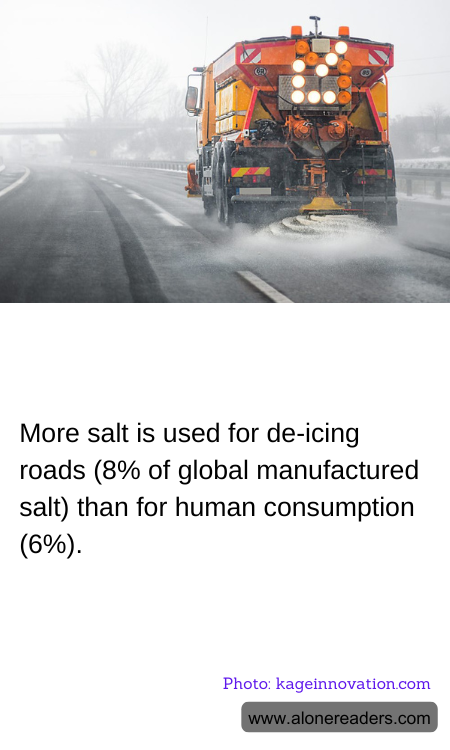
Salt, a common mineral comprised mainly of sodium chloride, has extensive applications beyond its well-known role in culinary settings. Perhaps surprisingly, a significant portion of globally manufactured salt is utilized for purposes other than seasoning or preserving food. One of its major uses is for de-icing roads during winter months, which consumes about 8% of the world’s salt production. This is actually more than the salt used for direct human consumption, which accounts for only about 6% of the global output.
The reason behind this large-scale usage of salt for de-icing lies in its chemical properties. Salt lowers the freezing point of water, which helps to prevent ice from forming and reduces the existing ice and snow on road surfaces into a liquid state that can be more easily managed. This is crucial for maintaining road safety during icy conditions. In countries with cold climates, such as Canada, parts of the United States, and northern Europe, road salt is an essential winter maintenance material that helps to keep roads passable during frozen weather.
However, the environmental implications of using salt as a de-icing agent have been a growing concern. When the ice melts, the salt doesn’t disappear; it gets washed away into nearby soils, streams, and rivers. This can lead to increased salinity levels which can have detrimental effects on freshwater ecosystems and potentially harm aquatic wildlife. It can also degrade soil quality and affect local vegetation adversely.
Efforts are being made to address these environmental concerns. Alternative de-icing substances such as beet juice, cheese brine, and even coffee grounds are being tested. These materials can be used alone or mixed with salt to reduce the amount needed. The goal is to maintain road safety while minimizing the environmental impact of traditional road salt.
Thus, while salt remains a staple in both kitchens and winter road maintenance, its application in large quantities for de-icing underscores a complex balance between human necessity and environmental stewardship. As we continue to depend on salt for various uses, finding more sustainable approaches to its application is increasingly becoming a priority.
