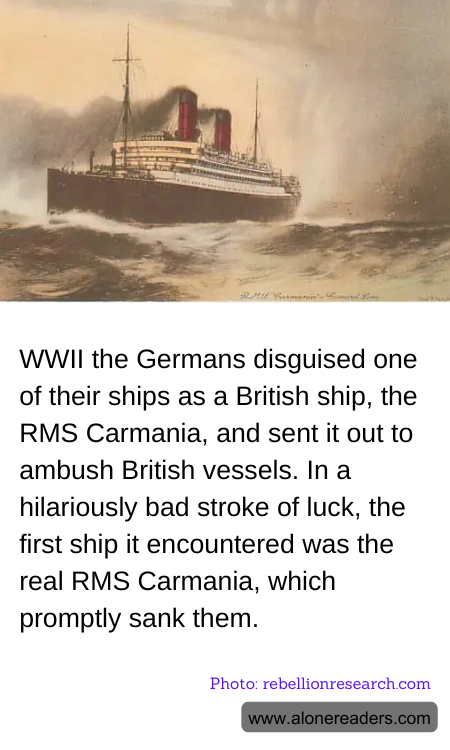
During World War I, in a remarkable twist of fate, naval warfare witnessed one of its most ironic encounters. The German ship SMS Cap Trafalgar, originally a passenger liner converted into an auxiliary cruiser, was involved in a bizarre and fateful duel that could rival any plot in a naval thriller.
As part of its war strategy, the German navy decided to disguise SMS Cap Trafalgar to look like the British RMS Carmania, a similar-looking passenger liner that had also been converted into an armed merchant cruiser by the British. The idea was to use the disguised SMS Cap Trafalgar to infiltrate and attack unsuspecting Allied shipping in the South Atlantic. The Germans meticulously altered the Cap Trafalgar's external features, repainting the hull and rearranging its deck structures to mimic the British vessel.
However, the plan took an improbable turn on September 14, 1914, near the Brazilian island of Trindade. The disguised SMS Cap Trafalgar encountered what appeared to be an easy target, but in a twist of profound irony, it was the actual RMS Carmania, under the command of Captain Noel Grant. Unbeknownst to the Germans, the real Carmania had been similarly armed and was on patrol for enemy raiders, effectively mirroring the role into which the Cap Trafalgar had been cast.
The ensuing battle was fierce and chaotic. Both ships, having undergone transformations into warships, exchanged heavy gunfire. The Carmania, battered by the German salvoes but resilient, managed to inflict devastating damage on the Cap Trafalgar. Despite the German crew's valiant efforts and superior number of guns, the Carmania utilized its tactical advantage and the element of surprise, compounded by the Cap Trafalgar's unstable makeshift weaponry.
After a relentless firefight, the Cap Trafalgar, overwhelmed by the damage sustained, began to sink. It eventually succumbed to the ocean, taking with it a significant portion of its crew, marking a poignant end to what had been a bold but ill-fated naval ruse. The Carmania, though victorious, did not emerge unscathed; it suffered considerable damage and casualties, necessitating significant repairs and a brief sojourn in Gibraltar for convalescence.
This encounter stands out in naval history not only for the sheer improbability of the enemy ships' identical disguises but also for the dramatic way in which fortune can dictate the outcome of military engagements. The battle of the Carmania and the Cap Trafalgar remains a testament to the unpredictable nature of war and the thin line between audacity and calamity.
