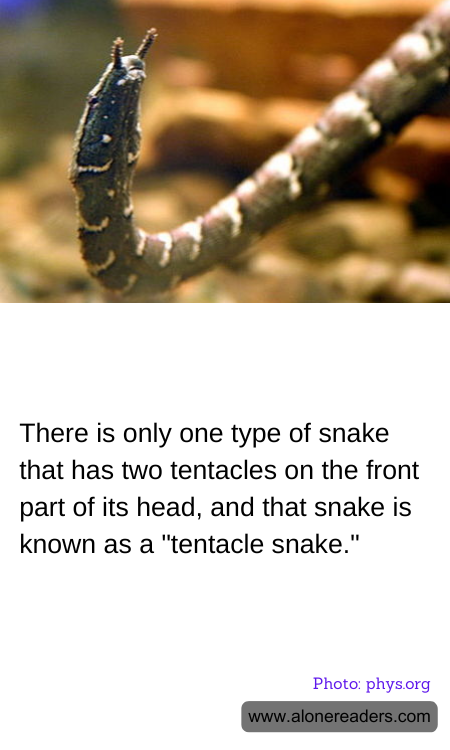
The tentacled snake (Erpeton tentaculatum) is a truly unique species within the realm of serpents, distinguished by its two distinct, fleshy tentacles protruding from its head. Native to the murky freshwater habitats of Southeast Asia, including Thailand, Cambodia, and Vietnam, this snake has adapted intriguingly to its aquatic environment. These tentacles are not just decorative; they play a pivotal role in the snake’s hunting technique. Positioned near the snake’s nostrils, the tentacles are equipped with sensory receptors that help in detecting vibrations from fish, which are the snake's primary prey.
The tentacled snake's body color and patterning provide excellent camouflage against the muddy riverbeds and dense vegetation of its habitat, making it nearly invisible to unsuspecting prey. By anchoring itself with its tail and remaining motionless, it can create a remarkable trap. When a fish approaches, reacting to the subtle water displacements made by the approaching prey, the snake strikes with astonishing speed and accuracy.
What’s even more fascinating is that research has shown that the tentacled snake can predict the future position of the fleeing fish. Studies have demonstrated that it accounts for the typical escape response of fish, thus aiming for the position where it expects the fish to be a moment after detecting the threat. This predictive ability, coupled with lightning-fast reflexes, makes the tentacled snake an efficient predator, despite its seemingly cumbersome method of lying in wait.
The reproductive habits of tentacled snakes are also adapted to their aquatic life. They are ovoviviparous, meaning the mother carries the eggs inside her until they hatch, giving birth to live, fully formed young snakes that are miniature replicas of the adults, equipped to swim and hunt immediately. This mode of reproduction ensures a higher survival rate for the offspring in their predator-filled aquatic environment.
Despite their fascinating nature, tentacled snakes are not commonly known outside of their native habitats, and they have not typically been the subject of extensive study compared to more widespread or iconic snake species. However, their unique adaptations and hunting strategies offer valuable insights into the evolutionary processes that shape the development of sensory systems and predatory techniques in the animal kingdom. The tentacled snake stands as a testament to the complexity and diversity of life forms evolving under different environmental pressures.
