More About This Card
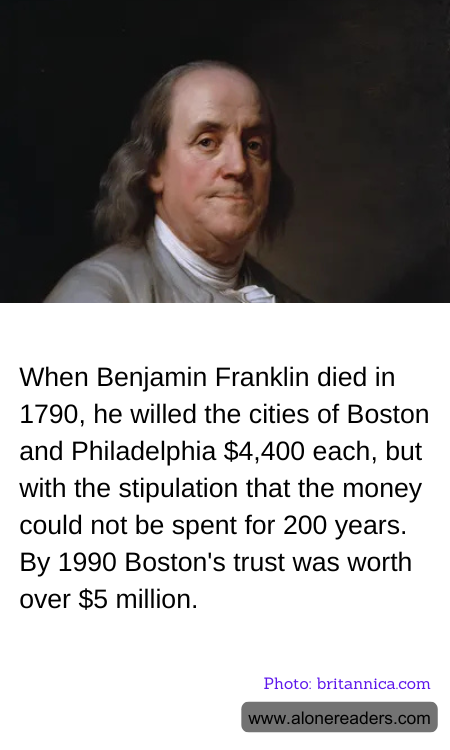
When Benjamin Franklin, one of the Founding Fathers of the United States, passed away in 1790, he left a legacy that was as innovative as his life had been. Among his various bequests, Franklin left an unusual financial gift to the cities of Boston and Philadelphia: $4,400 each, with the stipulation that the funds could not be spent for 200 years. Franklin's intention was to provide a long-term benefit to the cities he cherished, believing that even a small amount of capital, if wisely invested and allowed to grow over time, could result in substantial funds for public projects.
Franklin's foresight was remarkably accurate. By 1990, the end of the stipulated period, the trust funds had grown exponentially due to careful and judicious management. Boston's trust, in particular, had burgeoned to over $5 million. This significant growth in funds shows the power of compound interest and long-term investment—an economic principle Franklin had always advocated for during his lifetime.
The funds accumulated over the two centuries were earmarked for public projects that would benefit the residents of both cities. In Boston, the accumulated money from Franklin’s bequest was used to establish the Benjamin Franklin Institute of Technology, among other initiatives designed to enhance educational opportunities and support trade skills in the city. Philadelphia also utilized its windfall to support scholarships and fund various civic initiatives, living up to Franklin’s vision of supporting community welfare.
This story of Franklin's legacy is more than a historical footnote; it serves as a lesson in financial wisdom and philanthropy. His strategic use of a time-bound trust underscores the potential of long-term fiscal planning and investment. Moreover, Franklin's bequest also highlights his enduring commitment to the communities he valued, his belief in the transformative power of education, and his unwavering support for civic engagement. As cities and individuals today seek to plan for the future, Franklin’s 200-year-old gift remains a powerful testament to the lasting impact thoughtful financial planning can have on future generations.