More About This Card
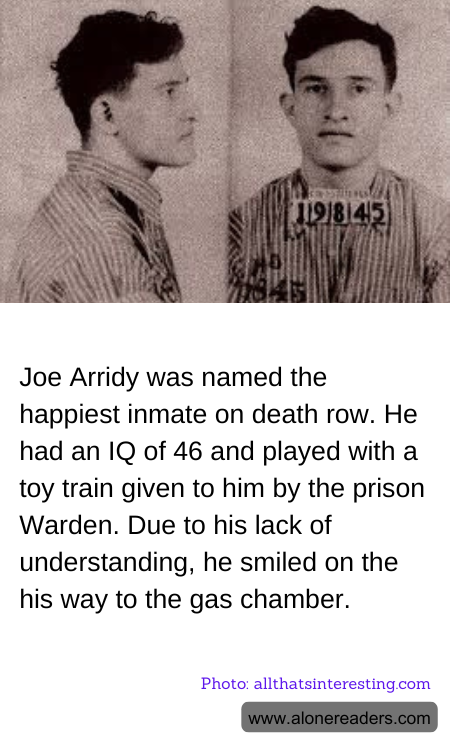
Joe Arridy’s story is a profound and sorrowful case within the annals of American criminal justice, raising poignant concerns about capital punishment and the treatment of the mentally disabled within the legal system. With an IQ of 46, Arridy was labeled the "happiest prisoner on death row" during his time at the Colorado State Penitentiary for a crime that many believe he did not understand, let alone commit.
Arridy was arrested in 1936 for the murder and sexual assault of a 15-year-old girl in Pueblo, Colorado. His conviction was largely based on a confession he gave to the police, which was highly questionable given his intellectual disabilities and his tendency to agree with leading statements. Subsequent investigations and reviews have suggested that Arridy did not have the capacity to understand his situation, the charges against him, or the implications of his own statements.
During his time on death row, Arridy was noted for his cheerful demeanor, a stark contrast to the grim realities surrounding him. This demeanor was poignantly captured in his attachment to a toy train, a gift from Warden Roy Best who saw his child-like nature. Best, who was known to be a strict warden, took an unusual liking to Arridy, recognizing his gentle and guileless nature. This simple toy became a symbol of Arridy’s innocence and a poignant detail that highlighted his mental state.
The case took a darker turn on January 6, 1939, when Arridy was led to the gas chamber. Witnesses reported that he was smiling, a disturbing testament to his lack of awareness of the fate that awaited him. This event sparked a significant backlash and became a focal point in discussions about the death penalty, particularly concerning individuals with mental disabilities.
In the years following his execution, evidence has mounted indicating Arridy’s innocence, including the confession of another man, Frank Aguilar, who was executed for the same crime. In 2011, nearly 72 years after his death, Arridy was posthumously pardoned by Colorado Governor Bill Ritter, acknowledging the grave miscarriage of justice. This pardon was a symbolic restoration of justice, albeit posthumously, emphasizing the tragic consequences of the state’s failure to protect its most vulnerable citizens.
Joe Arridy’s case is a sobering reminder of the critical need for justice reform, particularly concerning the death penalty and the treatment of those with intellectual disabilities. His story symbolizes the enduring fight against wrongful convictions and highlights the broader implications of human rights within the criminal justice system.