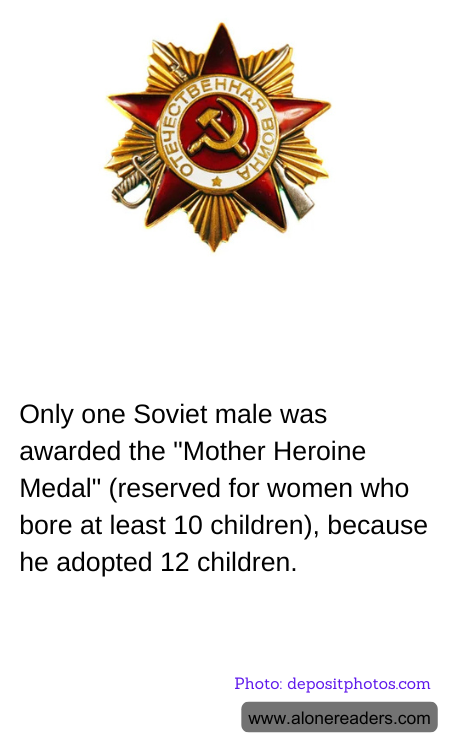
In the history of Soviet accolades, a rather unique instance occurred when a male citizen was awarded the "Mother Heroine" medal. This honor, typically reserved exclusively for women who gave birth to and raised at least 10 children, symbolized the Soviet government's appreciation for mothers who contributed to the growth of the communist society through large families. The award was established on July 8, 1944, by Joseph Stalin, and it not only recognized the recipient’s maternal contributions but also came with a financial reward of 2,000 rubles.
The distinction of being the only male recipient of the Mother Heroine medal was bestowed upon a man who demonstrated extraordinary commitment to child welfare by adopting 12 children. His story is a testament to the broader definitions of parenthood and caregiving that transcend conventional gender roles. Despite the award’s gender-specific title and criteria, his act of adopting and raising 12 children was recognized as equally significant in promoting the values intended to be celebrated by this medal.
This unique occurrence sheds light on the societal norms and expectations surrounding family and parenthood during the Soviet era. Typically, honorees were women who had biologically borne numerous children, reflecting traditional beliefs in women’s roles within the family. However, this unusual award case highlights a break from the norm and underscores the importance of parental care and love, irrespective of biological ties or traditional gender roles.
Moreover, this event indicates the flexibility in the Soviet system for recognizing substantial contributions to society, promoting a message that nurturing and raising the next generation is of paramount importance—a duty honored regardless of the individual’s gender. In recognizing a man with the Mother Heroine medal, the Soviet Union showcased an exceptional, though rare, open-mindedness towards roles within the family, emphasizing that the essence of parenthood lies in the commitment to nurturing and raising children.
