More About This Card
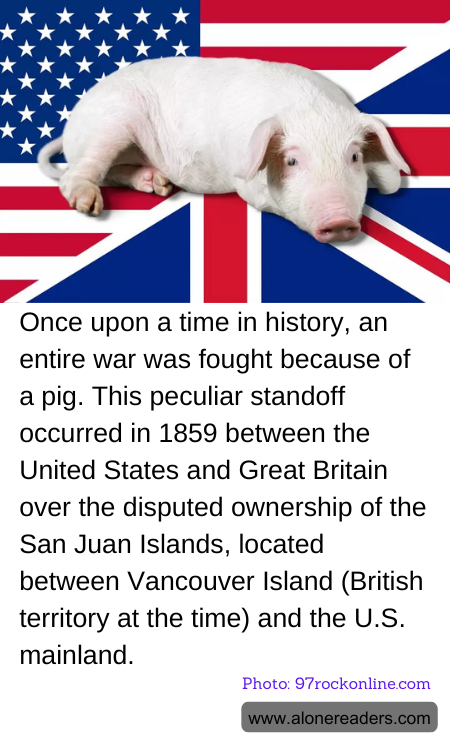
The conflict, peculiarly known as the Pig War, ignited when an American settler named Lyman Cutlar found a large black pig rooting through his garden on the island of San Juan, which he and other Americans had settled. The pig, which belonged to the Hudson's Bay Company and was owned by an Irishman, Charles Griffin, was feasting on Cutlar's potatoes. In a fit of anger, Cutlar shot the pig, igniting a series of events that nearly led to a full-scale war.
Charles Griffin demanded compensation from Cutlar, but they couldn't agree on the amount. Tensions, which had been simmering due to the ambiguous boundary terms of the Oregon Treaty of 1846, suddenly flared. The treaty had intended to draw the border between British North America and America along the “middle of the channel” separating the continent from Vancouver Island, but it did not specify which of several possible channels was meant, leaving San Juan up for grabs. The death of the pig became a tributary to the larger river of dispute over national pride and territorial control.
In response to the escalating situation, both nations dispatched troops to the island. The Americans, led by Captain George Pickett (who would later become famous as a Confederate general during the Civil War), began with a modest force of 66 men. The British responded by sending three warships under the command of Captain Geoffrey Hornby. The absurdity of two great nations teetering on the brink of war over a pig casualty led both military and civilian leaders to exercise restraint. Not a single shot was fired in anger during this "war".
Through diplomacy, tensions eased when officials from both nations agreed to a joint military occupation of the island, leaving the final settlement of the boundary issue to a later date. This joint garrison of British and American troops lasted for more than a decade, an era characterized more by cooperative boredom and mutual celebration than by conflict.
Finally, in 1872, the matter was settled by arbitration. The German Kaiser, acting as arbitrator, decided in favor of the United States, drawing the boundary through Haro Strait, thus making San Juan and the other disputed islands U.S. territory. The British withdrew without incident, and the San Juan Islands officially became part of the United States. The Pig War, having seen no human casualties and only one porcine victim, stands out in history as an example of how international conflicts can be resolved with minimal violence, albeit not without diplomatic complexity.