More About This Card
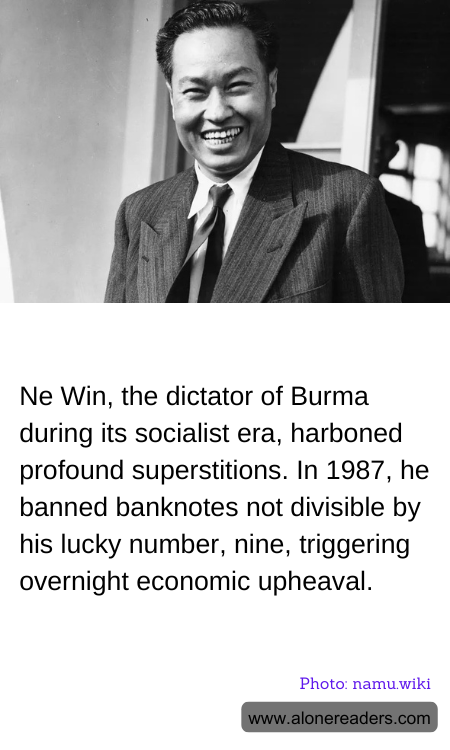
Ne Win, the enigmatic and authoritarian ruler of Burma, now Myanmar, left an indelible mark on the country's history through his unique blend of socialism and superstition. Rising to power in 1962 through a military coup, Ne Win's rule was characterized by an iron grip on the nation, steering it towards a socialist path that isolated Burma from much of the world. However, beyond his political maneuvers and economic policies, it was his profound superstitions that often bewildered both his supporters and detractors.
One of the most striking examples of Ne Win's reliance on numerology came in 1987, when he made a decision that would plunge the country into economic chaos overnight. Driven by his belief in the auspiciousness of the number nine, Ne Win ordered the demonetization of banknotes that were not divisible by this number. This sudden decree rendered the 25, 35, and 75 kyat notes obsolete, wiping out the savings of millions of Burmese citizens in an instant. The decision was not only economically disastrous but also deeply unpopular, sparking widespread discontent and protests.
The rationale behind this drastic move lay in Ne Win's conviction that the number nine would bring prosperity and stability to his regime. This belief was rooted in numerology, a system that assigns mystical significance to numbers, which Ne Win reportedly consulted frequently. His obsession with numerology was not limited to currency; it permeated various aspects of his governance, including the timing of important decisions and the structuring of military operations. However, the 1987 currency debacle stands out as a particularly stark illustration of how personal superstitions can have far-reaching consequences when wielded by those in power.
The economic upheaval caused by the demonetization was severe. With the sudden invalidation of widely used currency notes, ordinary citizens found themselves unable to access their savings, leading to financial ruin for many. The move also exacerbated the already struggling economy, which was suffering under the weight of Ne Win's socialist policies. The resulting public outrage contributed to the growing discontent that would eventually lead to the nationwide protests in 1988, known as the 8888 Uprising, which marked a significant turning point in Burma's political landscape.
Ne Win's legacy is a complex tapestry of authoritarian rule, economic mismanagement, and personal eccentricities. His reliance on superstition, particularly his fixation on the number nine, serves as a cautionary tale of how personal beliefs can intersect with political power to devastating effect. While his era has long passed, the impact of his decisions continues to be felt in Myanmar, offering lessons on the importance of rational governance and the dangers of allowing personal whims to dictate national policy.