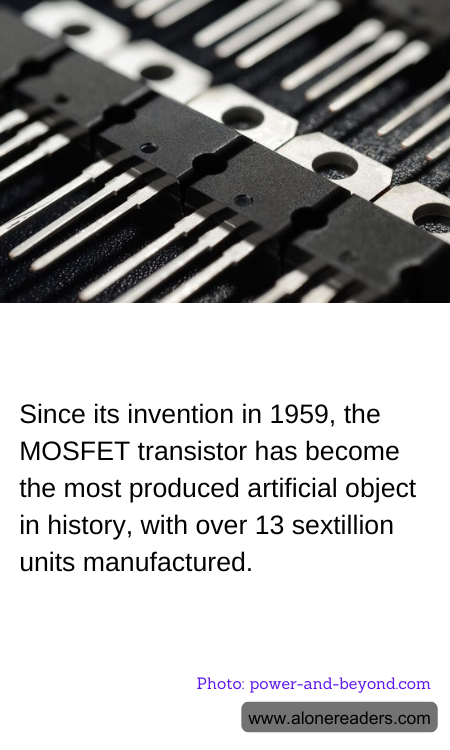
The invention of the Metal-Oxide-Semiconductor Field-Effect Transistor, or MOSFET, in 1959 marked a pivotal moment in the history of technology. Since its inception, the MOSFET has become the most produced artificial object in history, with over 13 sextillion units manufactured. This tiny yet powerful component has been instrumental in shaping the modern world, driving the evolution of electronics and enabling the digital age.
The MOSFET's significance lies in its ability to act as a switch or amplifier in electronic devices. Its design allows for efficient control of electrical signals, making it a fundamental building block in integrated circuits. The versatility and scalability of MOSFETs have allowed them to be used in a wide range of applications, from simple household electronics to complex computing systems. This adaptability has fueled the exponential growth in their production, as they are essential in everything from smartphones and computers to cars and industrial machinery.
One of the key reasons for the MOSFET's widespread adoption is its efficiency. It consumes less power and generates less heat compared to its predecessors, making it ideal for use in portable and energy-sensitive devices. This efficiency has been crucial in the development of smaller, faster, and more powerful electronic devices, aligning perfectly with the demands of modern technology. As a result, the MOSFET has played a central role in the miniaturization of electronics, a trend that has defined technological progress over the past few decades.
The impact of the MOSFET extends beyond just technological advancements. Its mass production has driven down the cost of electronic devices, making technology more accessible to people around the world. This democratization of technology has had profound social and economic implications, contributing to the rise of the information age and the global digital economy. The MOSFET has enabled innovations that have transformed industries, improved communication, and enhanced the quality of life for billions of people.
Looking to the future, the MOSFET continues to evolve. Researchers and engineers are constantly working to improve its performance and adapt it to new challenges, such as the growing demand for renewable energy and the development of artificial intelligence. As technology continues to advance, the MOSFET will undoubtedly remain a cornerstone of innovation, driving progress and shaping the world in ways we can only begin to imagine.
In conclusion, the MOSFET transistor is more than just a component; it is a catalyst for change and a testament to human ingenuity. Its unparalleled production numbers reflect its importance in the modern world, underscoring its role as a foundational element in the ongoing technological revolution. As we continue to push the boundaries of what is possible, the MOSFET will remain at the heart of our digital future, powering the devices and systems that define our lives.
