More About This Card
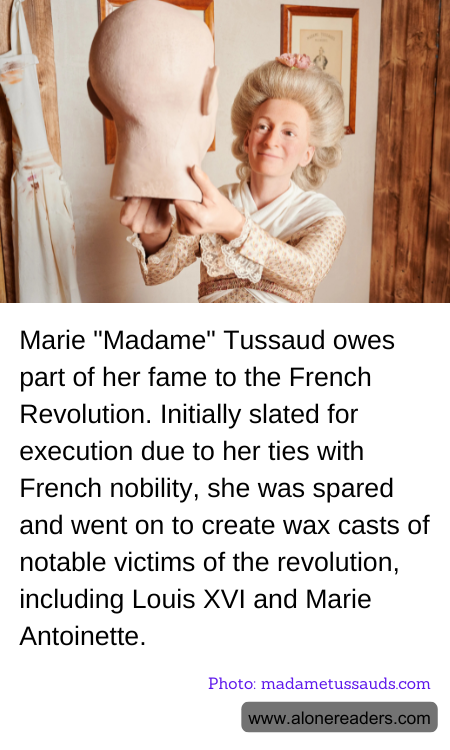
Marie "Madame" Tussaud's life story is as fascinating as the wax figures she meticulously crafted. Born in Strasbourg, France, in 1761, Marie Grosholtz, later known as Madame Tussaud, was introduced to the art of wax modeling at a young age. Her journey to becoming a household name in the world of wax museums is intertwined with the tumultuous events of the French Revolution, a period that not only threatened her life but also propelled her to fame.
Marie was trained under the tutelage of Philippe Curtius, a Swiss physician and wax sculptor, who took her under his wing. By the time she was in her teens, Marie was already displaying a remarkable talent for creating lifelike wax figures. Her skills earned her a position as an art tutor to the sister of King Louis XVI, which brought her into close contact with the French nobility. However, these connections would soon place her in grave danger.
As the French Revolution erupted in 1789, the political landscape of France underwent a dramatic transformation. The revolutionaries, fueled by a desire to dismantle the monarchy and eradicate the influence of the aristocracy, viewed anyone associated with the royal family with suspicion. Marie's ties to the nobility made her a target, and she was arrested and imprisoned, her fate seemingly sealed by the guillotine.
In a twist of fate, Marie's life was spared, thanks to her artistic skills and the intervention of influential friends. She was tasked with creating death masks of the revolution's most notable victims, a morbid yet significant role that would cement her legacy. Among her subjects were King Louis XVI and Queen Marie Antoinette, whose executions marked the end of an era and the beginning of Marie's rise to prominence.
These wax casts, created under the most harrowing of circumstances, became historical artifacts that captured the public's imagination. They offered a tangible connection to the dramatic events of the revolution, allowing people to come face-to-face with the likenesses of figures who had shaped history. Marie's work provided a unique form of storytelling, preserving the visages of both the famous and the infamous for posterity.
In 1802, Marie Tussaud moved to London, where she established her first permanent exhibition. Her wax museum quickly became a popular attraction, drawing visitors eager to see the lifelike representations of historical figures, celebrities, and notorious criminals. Madame Tussaud's legacy continues to thrive today, with her museums located in major cities around the world, each one a testament to her enduring impact on popular culture.
Marie Tussaud's remarkable journey from a young wax modeler to an iconic figure in the world of museums is a story of resilience and adaptability. Her ability to navigate the perilous waters of revolutionary France and emerge as a celebrated artist is a testament to her talent and tenacity. Through her work, she not only captured the likenesses of her contemporaries but also immortalized the spirit of an era that forever changed the course of history.