More About This Card
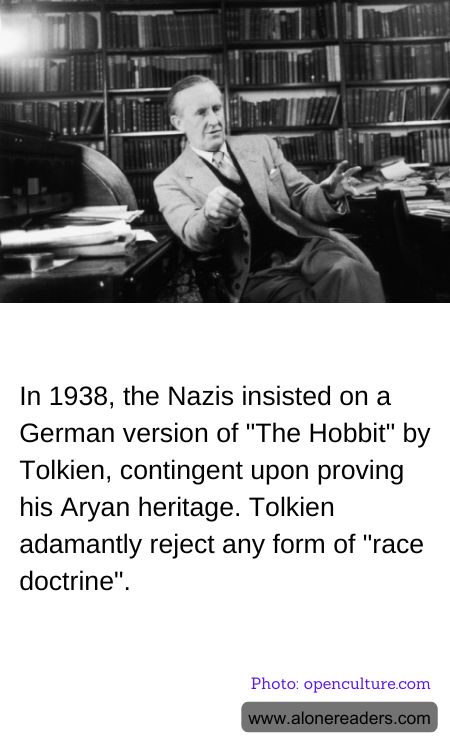
In 1938, as the world teetered on the brink of war, a peculiar and unsettling request was made to J.R.R. Tolkien, the esteemed author of "The Hobbit." The German publishing house Rütten & Loening, eager to translate and publish Tolkien's work for the German market, insisted on a condition that reflected the dark ideologies of the time. They required Tolkien to provide proof of his Aryan heritage, a demand rooted in the Nazi regime's obsession with racial purity.
Tolkien, a man of profound intellect and moral conviction, was confronted with a choice that tested his principles. The request was not merely a bureaucratic formality; it was an affront to his values and an embodiment of the racial doctrines he found abhorrent. In response, Tolkien crafted a letter that has since become a testament to his character and his rejection of the pernicious ideologies of the era.
In his reply, Tolkien expressed his disdain for the racial policies of the Nazis with eloquence and subtle defiance. He refused to comply with the demand, stating that he had no intention of participating in any form of racial certification. Instead, he offered a pointed critique of the very notion of racial superiority, highlighting the absurdity and moral bankruptcy of such beliefs. Tolkien's response was not only a personal stand but also a broader statement against the dehumanizing doctrines that were gaining traction across Europe.
Tolkien's rejection of the race doctrine was not merely an isolated incident but part of a larger tapestry of his beliefs. His works, rich with themes of diversity, unity, and the struggle against tyranny, reflect his deep-seated opposition to the ideologies that sought to divide and dehumanize. The world he created in his writings, populated by a myriad of races and cultures, stands in stark contrast to the homogeneous vision espoused by the Nazis.
This episode in Tolkien's life serves as a powerful reminder of the importance of standing firm in one's principles, even in the face of overwhelming pressure. It underscores the role of artists and intellectuals in challenging oppressive ideologies and highlights the enduring power of literature to inspire and provoke thought.
Today, as readers continue to delve into the rich worlds Tolkien created, his legacy as a writer and a moral compass endures. His refusal to acquiesce to the demands of the Nazi regime is a testament to his integrity and a beacon of hope for those who continue to fight against prejudice and intolerance in all its forms.