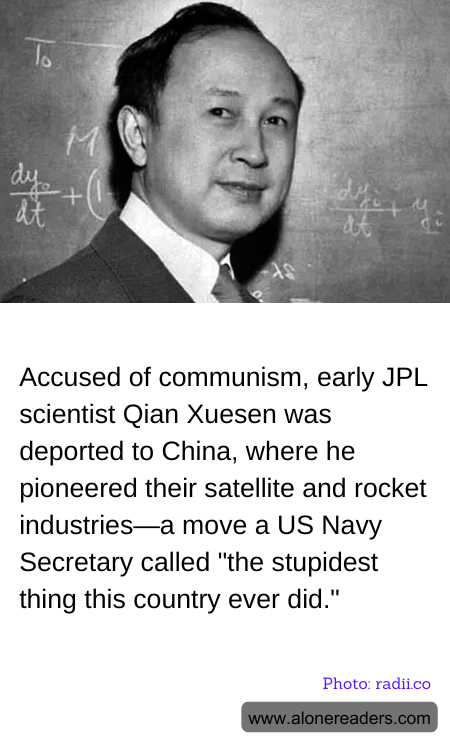
In the annals of history, few tales are as ironic and impactful as that of Qian Xuesen, a brilliant scientist whose forced departure from the United States inadvertently catalyzed the rise of China's aerospace prowess. Qian, a key figure in the early days of the Jet Propulsion Laboratory (JPL), found himself embroiled in the political paranoia of the McCarthy era. Accused of communist sympathies, he was deported to China in 1955, a decision that would have profound implications for global technological and military dynamics.
Qian Xuesen's journey began in China, but his academic pursuits led him to the United States, where he studied at the Massachusetts Institute of Technology and later at the California Institute of Technology. Under the mentorship of Theodore von Kármán, a leading figure in aerodynamics, Qian quickly established himself as a formidable mind in the field of rocket science. His work at JPL was instrumental in laying the groundwork for what would become the United States' space exploration efforts.
However, the political climate of the 1950s, marked by the Red Scare and a pervasive fear of communism, cast a shadow over Qian's career. Despite his contributions to American science, suspicions about his political affiliations led to his arrest and eventual deportation. The decision to send Qian back to China was not without controversy; it was later described by a U.S. Navy Secretary as "the stupidest thing this country ever did," a sentiment that underscores the magnitude of the oversight.
Upon his return to China, Qian was welcomed as a national hero. He quickly became a pivotal figure in the development of China's missile and space programs. His expertise and leadership were instrumental in the successful launch of China's first satellite, Dong Fang Hong 1, in 1970, and the development of the country's ballistic missile capabilities. Qian's work laid the foundation for China's burgeoning space industry, which has since become a major player on the global stage.
The story of Qian Xuesen is a poignant reminder of the unintended consequences of political decisions. His deportation not only deprived the United States of a brilliant scientist but also inadvertently bolstered China's technological advancements. Today, as nations continue to navigate the complexities of international relations and technological competition, Qian's legacy serves as a cautionary tale about the perils of allowing fear and suspicion to dictate policy.
In reflecting on Qian's life and contributions, it is clear that his story is not just about the past but also a lesson for the future. It highlights the importance of fostering an environment where scientific talent can thrive, free from the constraints of political bias. As the world continues to grapple with issues of security and innovation, the tale of Qian Xuesen remains a powerful testament to the enduring impact of one man's journey across borders and ideologies.
