More About This Card
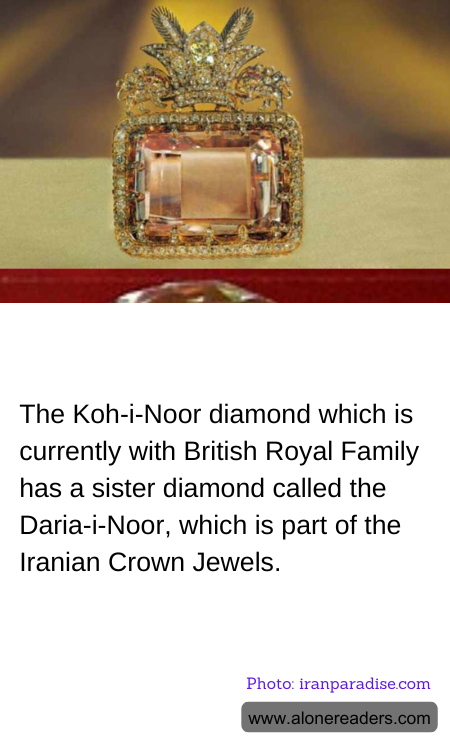
The Koh-i-Noor diamond, one of the most famous gemstones in the world, has long been a symbol of power and prestige. Currently part of the British Crown Jewels, this diamond has a storied history that spans centuries and continents. However, what many people might not know is that the Koh-i-Noor has a lesser-known counterpart, the Daria-i-Noor, which is an equally fascinating gem with its own rich history. The Daria-i-Noor, meaning "Sea of Light" in Persian, is a pale pink diamond that is part of the Iranian Crown Jewels.
The Daria-i-Noor and the Koh-i-Noor share a common origin, believed to have been mined from the Golconda mines in India, which were renowned for producing some of the world's most exquisite diamonds. These two gems were once part of the same collection, owned by the Mughal emperors who ruled over a vast empire in the Indian subcontinent. The diamonds were symbols of the emperors' immense wealth and power, often adorning their thrones and crowns.
In the mid-18th century, the Daria-i-Noor found its way to Persia (modern-day Iran) when Nader Shah, the ruler of Persia, invaded India and looted the treasures of the Mughal Empire. Among the spoils was the Daria-i-Noor, which became a prized possession of the Persian monarchy. Today, it remains a significant part of Iran's national heritage, housed in the Central Bank of Iran in Tehran, where it is displayed as part of the Iranian Crown Jewels.
The Koh-i-Noor, on the other hand, took a different path. After changing hands several times due to political upheavals and conquests, it eventually came into the possession of the British East India Company. In 1849, following the annexation of Punjab, the diamond was presented to Queen Victoria and became part of the British Crown Jewels. It has since been set into the crowns of various British queens and is currently on display at the Tower of London.
Both the Koh-i-Noor and the Daria-i-Noor have been the subjects of intrigue and controversy, with various countries laying claim to them over the years. The Koh-i-Noor, in particular, has been at the center of diplomatic discussions, with India, Pakistan, and Afghanistan all asserting ownership at different times. Despite these disputes, the diamonds remain where they are, each serving as a testament to the complex histories of the regions they hail from.
The stories of the Koh-i-Noor and the Daria-i-Noor are not just tales of glittering stones but are deeply intertwined with the histories of empires, conquests, and cultural exchanges. They remind us of the enduring allure of these precious gems and their ability to capture the imagination of people across the world. As symbols of both beauty and power, the Koh-i-Noor and the Daria-i-Noor continue to fascinate and inspire, each in their own unique way.