More About This Card
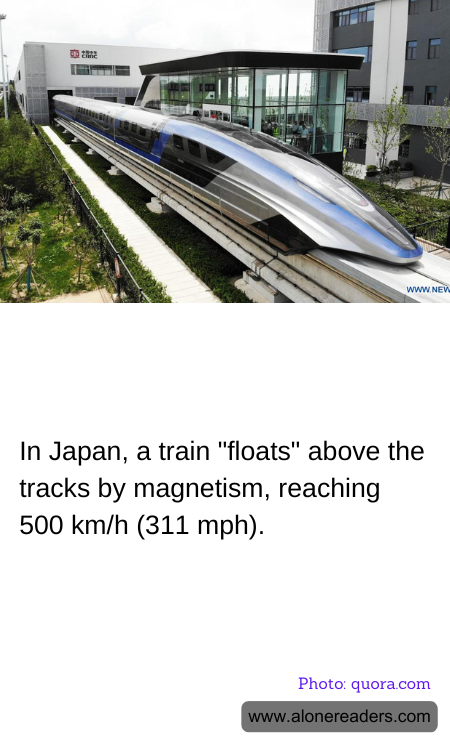
In the realm of transportation, Japan has long been a pioneer, consistently pushing the boundaries of speed and efficiency. One of the most remarkable advancements in recent years is the development of the magnetic levitation train, or maglev, which astonishingly "floats" above the tracks, reaching speeds of up to 500 kilometers per hour (311 miles per hour). This technological marvel is not only a testament to human ingenuity but also a glimpse into the future of high-speed travel.
The maglev train operates on the principle of magnetic levitation, a technology that eliminates the friction between the train and the tracks. Unlike traditional trains that rely on wheels and rails, the maglev uses powerful magnets to lift the train slightly above the track, allowing it to glide smoothly and silently. This lack of physical contact significantly reduces friction, enabling the train to achieve unprecedented speeds while maintaining a remarkably quiet ride.
Japan's maglev train, known as the Chuo Shinkansen, is a product of decades of research and development. The train's ability to reach such high speeds is made possible by superconducting magnets, which create a magnetic field strong enough to lift and propel the train forward. This cutting-edge technology not only enhances speed but also improves energy efficiency, making the maglev an environmentally friendly alternative to conventional rail systems.
The introduction of the maglev train is set to revolutionize travel in Japan, drastically reducing travel times between major cities. For instance, the journey between Tokyo and Nagoya, which currently takes about 100 minutes by the fastest bullet train, will be cut down to just 40 minutes with the maglev. This reduction in travel time is expected to have a significant impact on business, tourism, and daily commuting, further strengthening Japan's economic and social connectivity.
Beyond its practical benefits, the maglev train represents a significant step forward in sustainable transportation. By reducing reliance on fossil fuels and minimizing carbon emissions, the maglev aligns with global efforts to combat climate change. Its development underscores Japan's commitment to innovation and sustainability, setting a benchmark for other countries to follow.
As the world looks towards the future of transportation, Japan's maglev train stands as a beacon of what is possible when technology and vision converge. It not only promises to transform the way people travel but also inspires a new era of technological advancement. With its combination of speed, efficiency, and environmental consciousness, the maglev train is poised to redefine the landscape of high-speed rail travel, offering a glimpse into a future where the boundaries of distance and time are continually reimagined.