More About This Card
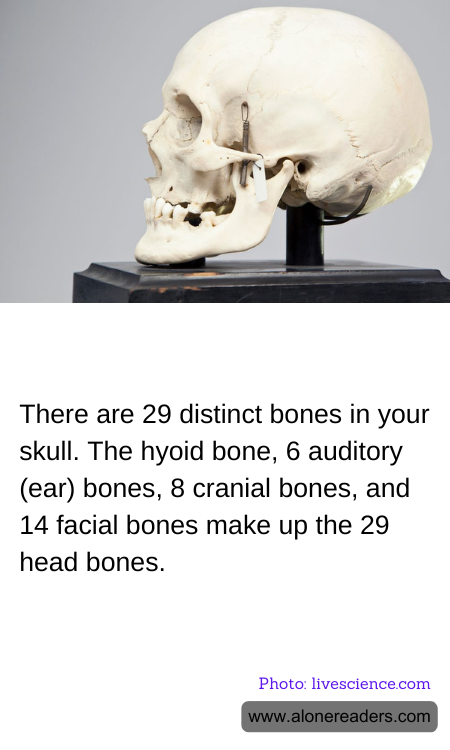
The human skull is a marvel of biological engineering, a complex structure that not only houses and protects the brain but also supports the sensory organs and forms the framework of the face. Comprising 29 distinct bones, the skull is a testament to the intricate design of the human body. These bones are categorized into four main groups: the hyoid bone, the auditory bones, the cranial bones, and the facial bones.
The hyoid bone is a unique component of the skull. Unlike other bones, it does not directly articulate with any other bone. Instead, it is anchored by muscles and ligaments, serving as a support structure for the tongue and playing a crucial role in swallowing and speech. Its horseshoe shape is strategically positioned in the neck, providing a foundation for the tongue and assisting in the complex mechanics of vocalization.
The auditory bones, also known as the ossicles, are a set of six tiny bones located in the middle ear. These are the smallest bones in the human body and are crucial for hearing. The ossicles consist of the malleus, incus, and stapes in each ear. They work together to transmit sound vibrations from the eardrum to the inner ear, amplifying the sound waves and allowing us to perceive a wide range of sounds. Without these delicate bones, the process of hearing would be significantly impaired.
The cranial bones form the protective casing around the brain, consisting of eight bones: the frontal, two parietal, two temporal, occipital, sphenoid, and ethmoid bones. These bones are fused together by sutures, which are immovable joints that provide strength and stability to the skull. The cranial bones not only protect the brain from injury but also provide attachment points for muscles and support the structure of the head.
The facial bones, numbering 14, create the structure of the face and provide cavities for the sense organs. These include the nasal bones, maxillae, zygomatic bones, palatine bones, lacrimal bones, inferior nasal conchae, vomer, and mandible. Each bone has a specific function, from forming the bridge of the nose to housing the upper teeth and forming the jaw. The facial bones also play a vital role in facial expressions, allowing us to convey emotions and communicate non-verbally.
Together, these 29 bones form a complex and dynamic system that is essential for many of the functions we often take for granted. From protecting the brain and enabling hearing to supporting facial expressions and speech, the bones of the skull are integral to our daily lives. Understanding the structure and function of these bones not only highlights the complexity of human anatomy but also underscores the remarkable capabilities of the human body.