More About This Card
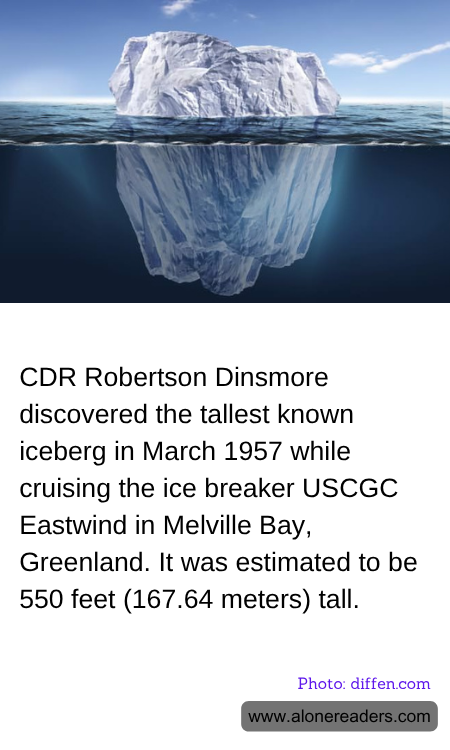
In the icy expanse of Melville Bay, Greenland, a remarkable discovery was made in March 1957 that would capture the imagination of explorers and scientists alike. Commander Robertson Dinsmore, while navigating the formidable icebreaker USCGC Eastwind, encountered an iceberg of unprecedented stature. This towering natural wonder was estimated to be 550 feet (167.64 meters) tall, making it the tallest known iceberg at the time.
The discovery of such a colossal iceberg was not only a testament to the raw power and beauty of nature but also highlighted the challenges faced by those who venture into the Arctic's frigid waters. Icebergs of this magnitude are rare, and their sheer size can pose significant navigational hazards. The USCGC Eastwind, a vessel specifically designed to break through thick ice, was well-equipped for such encounters, yet the sight of the towering iceberg was awe-inspiring even for seasoned sailors.
Icebergs are born from glaciers, massive rivers of ice that slowly flow from the interior of continents to the sea. As they reach the ocean, chunks of ice break off, a process known as calving, forming icebergs. The size of an iceberg is often deceptive, as only about one-eighth of its mass is visible above the waterline. This means that the iceberg discovered by CDR Dinsmore extended much deeper into the ocean, making its total size even more impressive.
The 1957 discovery underscored the importance of scientific exploration in understanding the dynamics of polar regions. Icebergs play a crucial role in the Earth's climate system, influencing ocean currents and marine ecosystems. The study of these icy giants provides valuable insights into the effects of climate change, as warming temperatures lead to increased calving and the formation of more icebergs.
For CDR Robertson Dinsmore and his crew aboard the USCGC Eastwind, the encounter with the towering iceberg was a moment of wonder and a reminder of the unpredictable nature of the Arctic environment. It served as a call to action for continued exploration and study of these remote regions, where the forces of nature are both majestic and formidable.
Today, the story of the tallest known iceberg discovered in Melville Bay remains a fascinating chapter in the history of polar exploration. It stands as a symbol of the enduring human spirit to explore and understand the natural world, inspiring future generations to venture into the unknown and uncover the secrets hidden within the icy realms of our planet.