More About This Card
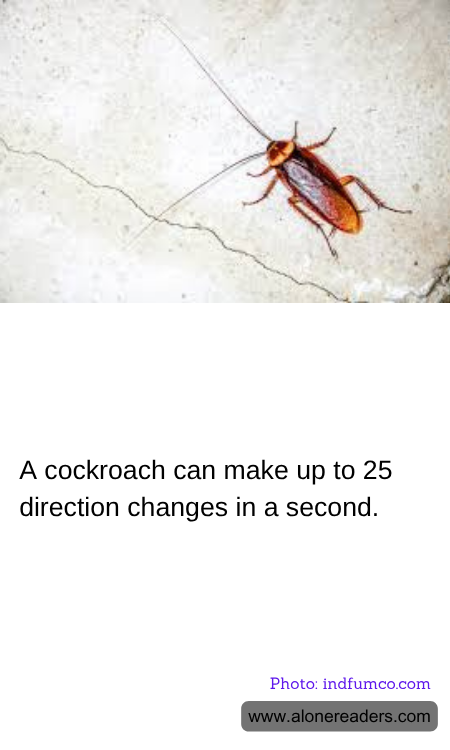
In the world of insects, the cockroach often stands out as a creature of resilience and adaptability. One of the most fascinating aspects of this often-misunderstood insect is its remarkable agility. A cockroach can make up to 25 direction changes in a single second, a feat that underscores its evolutionary success and ability to evade predators.
This incredible agility is largely due to the cockroach's unique anatomy and nervous system. Cockroaches have a highly developed set of sensory organs that allow them to detect changes in their environment almost instantaneously. Their antennae are particularly sensitive, picking up vibrations and chemical signals that alert them to potential threats. This sensory information is processed rapidly by their nervous system, enabling them to react with lightning speed.
The cockroach's legs are also a marvel of biological engineering. Each of its six legs is equipped with specialized muscles and joints that allow for quick, precise movements. This enables the cockroach to pivot and dart in different directions with minimal effort. The combination of sensory acuity and muscular coordination allows these insects to navigate complex environments with ease, whether they are scuttling across a kitchen floor or weaving through the underbrush.
This ability to change direction so swiftly is not just a survival mechanism but also a testament to the cockroach's evolutionary history. Over millions of years, cockroaches have adapted to a wide range of habitats, from tropical forests to urban dwellings. Their agility has been a key factor in their ability to thrive in diverse environments and avoid predators. In fact, this quickness is one reason why cockroaches have been able to survive for over 300 million years, outlasting many other species.
For humans, the cockroach's agility can be both a source of fascination and frustration. While their ability to evade capture makes them a challenging pest to manage, it also highlights the complexity and efficiency of natural evolution. Scientists continue to study cockroaches to better understand the mechanics of their movement, which could have applications in robotics and other fields. By mimicking the cockroach's rapid directional changes, engineers hope to develop more agile robots capable of navigating difficult terrains.
In conclusion, the cockroach's ability to make up to 25 direction changes in a second is a remarkable example of nature's ingenuity. This agility not only ensures their survival but also offers valuable insights into the mechanics of movement and adaptation. While they may not be the most beloved creatures, cockroaches undeniably hold a unique place in the natural world, showcasing the incredible potential of evolution and adaptation.