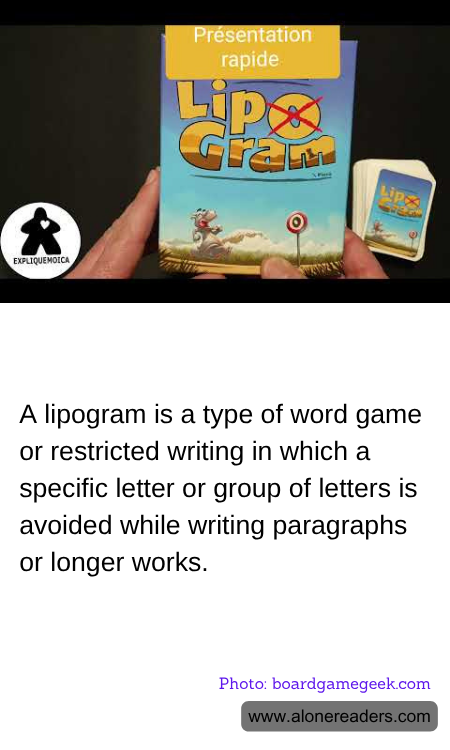
More About This Card
A lipogram is a fascinating form of constrained writing that challenges authors to create text while deliberately avoiding a particular letter or group of letters. This literary technique, which has been employed for centuries, transforms the writing process into a unique puzzle, requiring creativity and linguistic dexterity. The absence of a commonly used letter, such as 'e', can significantly alter the way sentences are constructed, pushing writers to explore alternative vocabulary and sentence structures.
The origins of lipograms can be traced back to ancient Greece, where writers would omit certain letters to demonstrate their skill and ingenuity. One of the most famous examples is the work of the Greek poet Tryphiodorus, who composed an entire version of the "Odyssey" without using the letter 'a'. This tradition continued through the ages, with various authors embracing the challenge to showcase their literary prowess. In more recent times, French author Georges Perec famously wrote the novel "La Disparition" (translated as "A Void") without using the letter 'e', one of the most frequently used letters in the French language. The English translation by Gilbert Adair also adheres to this constraint, demonstrating the lipogram's potential for cross-linguistic creativity.
Lipograms are not just exercises in linguistic gymnastics; they also offer readers a fresh perspective on language. By removing a common letter, writers are forced to think outside the box, often resulting in innovative expressions and unexpected turns of phrase. This can make reading a lipogram an engaging and thought-provoking experience, as readers become acutely aware of the constraints and marvel at the author's ability to navigate them.
For writers, crafting a lipogram can be both a challenging and rewarding endeavor. It requires a deep understanding of language and a willingness to experiment with different words and structures. The process can also enhance a writer's vocabulary, as they must often seek out synonyms or rephrase sentences to adhere to the constraints. This can lead to a richer, more varied writing style that benefits both the writer and their audience.
In the digital age, where communication is often rapid and informal, the art of the lipogram serves as a reminder of the beauty and complexity of language. It encourages both writers and readers to slow down and appreciate the intricacies of word choice and sentence construction. Whether used as a playful exercise or a serious literary pursuit, lipograms continue to captivate and inspire, proving that sometimes, less truly is more.