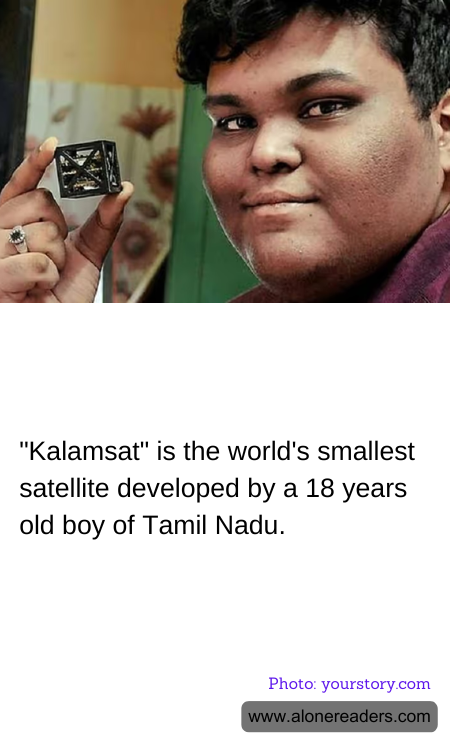
In a remarkable achievement that has captured the imagination of people worldwide, an 18-year-old boy from Tamil Nadu, India, has developed the world's smallest satellite, aptly named "Kalamsat." This groundbreaking innovation not only showcases the ingenuity and potential of young minds but also highlights the growing prominence of India in the global space community.
Kalamsat, weighing just 64 grams, is a testament to the creativity and determination of its creator, Rifath Sharook. The satellite was named in honor of Dr. A.P.J. Abdul Kalam, the former President of India and a renowned aerospace scientist, whose legacy continues to inspire young innovators across the nation. Rifath's achievement is particularly noteworthy as it was accomplished with limited resources, underscoring the power of perseverance and the spirit of innovation.
The satellite was developed as part of a competition organized by Cubes in Space, a program run by NASA and the global education company I Doodle Learning. The competition challenged students to design and build a small, lightweight satellite that could be launched into space. Rifath's design was selected from among numerous entries, earning him the opportunity to have Kalamsat launched by NASA.
Kalamsat's primary mission is to demonstrate the performance of 3D-printed carbon fiber, a material that is increasingly being used in aerospace applications due to its lightweight and durable properties. The satellite is equipped with sensors to measure temperature, radiation levels, and other environmental factors in space. Despite its diminutive size, Kalamsat is packed with technology that could pave the way for future advancements in satellite design and space exploration.
The successful launch of Kalamsat is a significant milestone not only for Rifath but also for the Indian space community. It highlights the potential of young innovators to make meaningful contributions to the field of space technology. Moreover, it serves as an inspiration to students worldwide, demonstrating that age and resources are not barriers to achieving great things.
Rifath's journey from a small town in Tamil Nadu to the global stage is a story of passion, hard work, and the pursuit of dreams. His achievement has been celebrated by educators, scientists, and space enthusiasts alike, who see in him a symbol of the next generation of innovators. It also emphasizes the importance of providing opportunities and support for young talents to explore their interests and develop their skills.
In conclusion, Kalamsat is more than just the world's smallest satellite; it is a beacon of hope and a reminder of the boundless possibilities that lie ahead when young minds are encouraged to dream big and think creatively. As the world continues to watch the skies, the story of Kalamsat and its young creator will undoubtedly inspire many more to reach for the stars.
