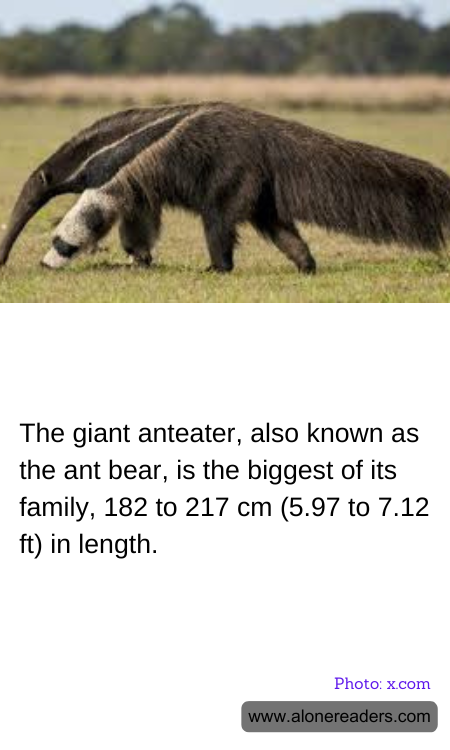
The giant anteater, often referred to as the ant bear, is a fascinating creature that captures the imagination of nature enthusiasts and casual observers alike. As the largest member of its family, the giant anteater boasts an impressive size, measuring between 182 to 217 centimeters (approximately 5.97 to 7.12 feet) in length. This unique mammal is a marvel of evolution, perfectly adapted to its environment and specialized in its dietary habits.
Native to Central and South America, the giant anteater inhabits a variety of ecosystems, from grasslands and savannas to rainforests. Its distinctive appearance is characterized by a long, bushy tail, a narrow head, and an elongated snout, which houses a sticky tongue that can extend up to two feet. This specialized tongue is a crucial tool for the anteater, allowing it to consume up to 30,000 ants and termites in a single day. The anteater's powerful forelimbs, equipped with sharp claws, are used to tear open ant hills and termite mounds, providing access to its primary food sources.
Despite its formidable size and strength, the giant anteater is a solitary and generally non-aggressive animal. It relies on its keen sense of smell to locate food, as its eyesight is relatively poor. When threatened, the anteater can defend itself with its strong claws, but it typically prefers to avoid confrontation. Its unique gait, with the forelimbs turned inward, gives it a distinctive walking style that adds to its charm.
The giant anteater plays a vital role in its ecosystem, controlling insect populations and contributing to the biodiversity of its habitat. However, this remarkable creature faces numerous threats, including habitat destruction, road accidents, and hunting. Conservation efforts are crucial to ensuring the survival of the giant anteater, as its population continues to decline in many areas. Organizations and researchers are working tirelessly to protect these animals and their habitats, raising awareness about their ecological importance.
For those fortunate enough to observe a giant anteater in the wild, it is an unforgettable experience. Its gentle demeanor and unique adaptations make it a symbol of the diverse and intricate web of life that thrives in the world's ecosystems. By understanding and appreciating the giant anteater, we can foster a greater sense of responsibility towards preserving the natural world and the incredible creatures that inhabit it.
