More About This Card
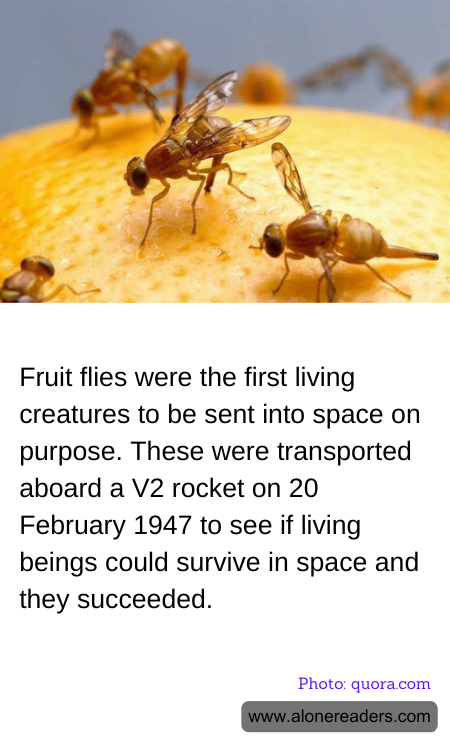
In the annals of space exploration, the names of pioneering astronauts and cosmonauts often take center stage. However, the first living creatures to venture beyond Earth's atmosphere were not humans, but rather a group of humble fruit flies. On February 20, 1947, these tiny insects embarked on a groundbreaking journey aboard a V2 rocket, marking a significant milestone in the quest to understand the effects of space travel on living organisms.
The decision to send fruit flies into space was driven by their biological simplicity and rapid life cycle, making them ideal subjects for scientific study. Researchers were keen to determine whether living beings could survive the harsh conditions of space, including exposure to cosmic radiation and the vacuum of space. The V2 rocket, a remnant of World War II technology, was repurposed for this mission, carrying its precious cargo to an altitude of approximately 68 miles (109 kilometers) above the Earth.
As the rocket soared into the sky, the fruit flies were subjected to the rigors of space travel. The mission's primary objective was to assess the impact of radiation exposure on living tissue, a critical factor in planning future human spaceflights. Upon the rocket's return to Earth, scientists eagerly examined the fruit flies, finding them alive and well. This successful mission provided the first concrete evidence that living organisms could endure the conditions of space, paving the way for more ambitious endeavors.
The fruit fly mission of 1947 was a pivotal moment in the history of space exploration. It demonstrated the feasibility of sending living creatures beyond our planet and laid the groundwork for subsequent missions involving more complex organisms, including primates and eventually humans. The data gathered from these early experiments contributed to the development of life-support systems and protective measures that would be essential for human space travel.
Beyond its scientific significance, the fruit fly mission also captured the imagination of the public, highlighting the potential for space exploration to unlock new frontiers of knowledge. It underscored the importance of interdisciplinary collaboration, as biologists, engineers, and physicists worked together to achieve a common goal. This spirit of cooperation continues to drive advancements in space exploration today.
In retrospect, the journey of the fruit flies aboard the V2 rocket was a small step for insects but a giant leap for science. It marked the beginning of an era where the mysteries of space could be explored not just through telescopes and theories, but through direct experimentation with living organisms. As we continue to push the boundaries of what is possible in space exploration, the legacy of these pioneering fruit flies serves as a reminder of the humble beginnings from which great achievements can arise.