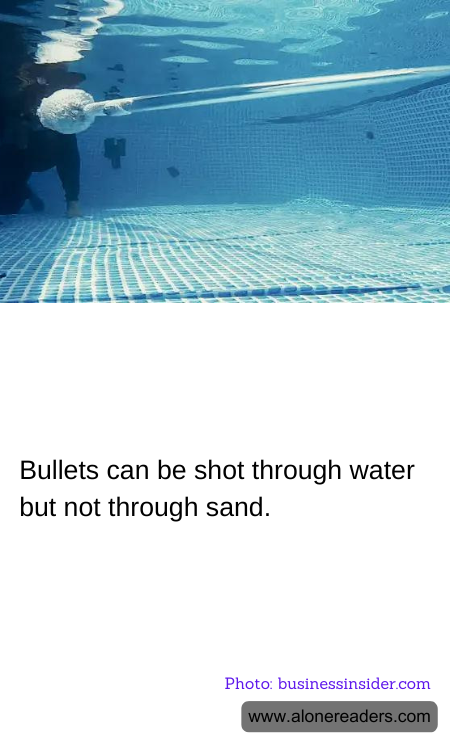
The fascinating dynamics of how bullets interact with different materials can be both surprising and enlightening. While it might seem intuitive that a bullet, with its high velocity and penetrating power, could easily pass through both water and sand, the reality is more complex. The behavior of bullets in these mediums is dictated by the principles of physics, particularly the concepts of resistance and density.
When a bullet is fired into water, it encounters resistance but can still travel a significant distance. This is because water, although denser than air, is a fluid that allows the bullet to maintain some of its velocity. The bullet's streamlined shape helps it cut through the water, albeit at a reduced speed. However, the bullet's speed decreases rapidly due to the water's density and the drag force acting against it. Despite this, bullets can still travel several feet underwater, depending on their initial speed and the angle at which they enter the water. This is why underwater firearms are designed to accommodate these dynamics, allowing for effective use in aquatic environments.
In contrast, sand presents a different challenge. Sand is a granular material composed of tiny particles that can shift and compact under pressure. When a bullet strikes sand, it encounters a medium that is not only dense but also capable of absorbing and dissipating energy quickly. The irregular shape and varying sizes of sand particles create a chaotic environment that disrupts the bullet's trajectory almost immediately. As the bullet penetrates the sand, it loses energy rapidly due to the friction and resistance from the compacted particles. This energy dissipation is so effective that bullets often come to a stop within just a few inches of entering the sand, making it an excellent material for bullet traps and backstops in shooting ranges.
The difference in how bullets behave in water versus sand highlights the importance of understanding material properties and their interactions with high-speed objects. Water's fluid nature allows for some degree of penetration, while sand's granular structure provides an almost immediate halt to a bullet's progress. This knowledge is not only crucial for designing safe shooting environments but also has applications in fields such as ballistics research and military strategy, where understanding the limitations and capabilities of firearms in various conditions can be critical.
In summary, the ability of bullets to penetrate water but not sand is a testament to the complex interplay between speed, resistance, and material properties. It serves as a reminder of the intricate laws of physics that govern our world, influencing everything from everyday activities to specialized fields of study. Whether for educational purposes or practical applications, appreciating these dynamics can lead to safer practices and more informed decisions in the use of firearms.
