More About This Card
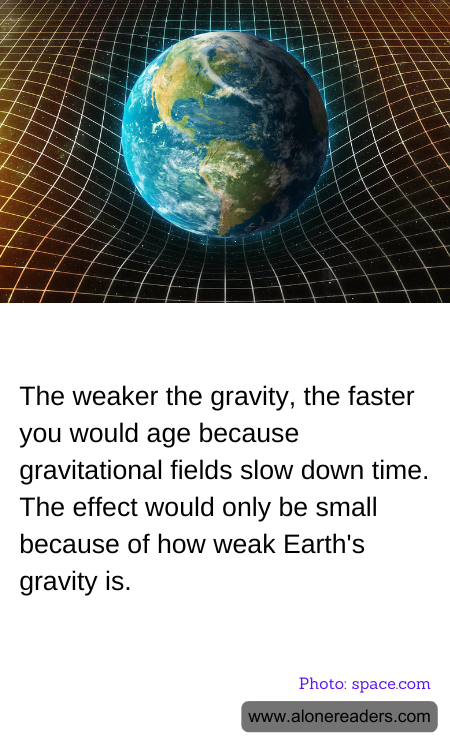
In the fascinating realm of physics, the relationship between gravity and time is a concept that has intrigued scientists and laypeople alike. This relationship is rooted in Albert Einstein's theory of general relativity, which posits that gravity is not just a force but a curvature in the fabric of space-time. One of the intriguing implications of this theory is that gravitational fields can influence the passage of time, a phenomenon known as gravitational time dilation.
Gravitational time dilation suggests that the stronger the gravitational field, the slower time passes. Conversely, in regions where gravity is weaker, time moves more swiftly. This means that if you were to live in a place with significantly weaker gravity than Earth's, you would age faster relative to someone on Earth. However, it's important to note that Earth's gravity is relatively weak in the cosmic scale, so the effect on aging is minuscule and imperceptible in our daily lives.
To illustrate this concept, consider the difference in time experienced by astronauts aboard the International Space Station (ISS) compared to people on Earth. The ISS orbits Earth at a high speed and at an altitude where Earth's gravitational pull is weaker than on the surface. As a result, time for astronauts on the ISS moves slightly faster than for those on Earth. However, the difference is so tiny that it amounts to only a fraction of a second over the course of an entire year.
This phenomenon is not just a theoretical curiosity but has practical implications in our technology. For instance, the Global Positioning System (GPS) relies on precise time measurements. Satellites in orbit experience less gravitational pull than devices on Earth, causing their clocks to tick slightly faster. Engineers must account for this discrepancy to ensure the accuracy of GPS systems, which are crucial for navigation and various other applications.
While the idea of aging faster in weaker gravitational fields might sound like science fiction, it is a testament to the intricate and interconnected nature of the universe. It highlights how our understanding of time, a seemingly constant and universal experience, can be influenced by the forces that govern the cosmos. For most of us, the effects of Earth's gravity on time are negligible, but they serve as a reminder of the wonders of physics and the endless possibilities for discovery in the universe.
In essence, the interplay between gravity and time is a captivating example of how the universe operates on principles that challenge our everyday perceptions. It invites us to ponder the mysteries of time and space, encouraging a deeper appreciation for the scientific advancements that continue to unravel the complexities of our world.