More About This Card
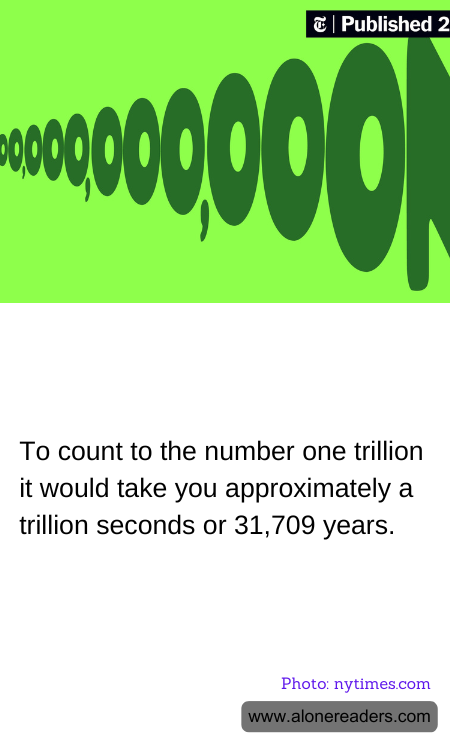
Counting to one trillion is a task that stretches the imagination and challenges our perception of time. To truly grasp the enormity of this number, consider this: counting to one trillion, at the rate of one number per second, would take approximately one trillion seconds. This staggering amount of time translates to about 31,709 years. Such a timeframe is not only beyond the span of a human lifetime but also exceeds the duration of recorded human history.
To put this into perspective, if you started counting at the dawn of human civilization, around 10,000 BCE, you would still be counting today and would continue to do so for tens of thousands of years into the future. This exercise highlights the vastness of large numbers and the limitations of our human experience in comprehending them. It also serves as a reminder of the incredible scale of the universe and the challenges we face in understanding it.
The concept of a trillion is often used in discussions about national economies, scientific data, and technological advancements. For instance, governments may discuss budgets in the trillions of dollars, and scientists may measure distances in trillions of kilometers when exploring the cosmos. These contexts require us to think beyond our everyday experiences and appreciate the magnitude of such figures.
Understanding large numbers like a trillion is crucial in a world where data and information are growing exponentially. As technology advances, we generate and process vast amounts of data, often measured in terabytes and petabytes, which are themselves composed of trillions of bytes. This data is essential for innovations in fields such as artificial intelligence, climate science, and medicine, where large datasets are analyzed to uncover patterns and make predictions.
The exercise of counting to a trillion also invites reflection on the nature of time itself. It prompts us to consider how we measure and value time in our lives. While a trillion seconds is an unfathomable length of time, it is a mere blink in the cosmic scale of the universe, which has existed for approximately 13.8 billion years. This perspective encourages us to appreciate the fleeting nature of our existence and the importance of making the most of the time we have.
In conclusion, the notion of counting to one trillion serves as a fascinating exploration of numbers, time, and our place in the universe. It challenges us to expand our understanding and appreciate the scale of the world around us. Whether in the context of economics, science, or personal reflection, grappling with such large numbers can inspire awe and curiosity, driving us to explore further and learn more about the universe we inhabit.