More About This Card
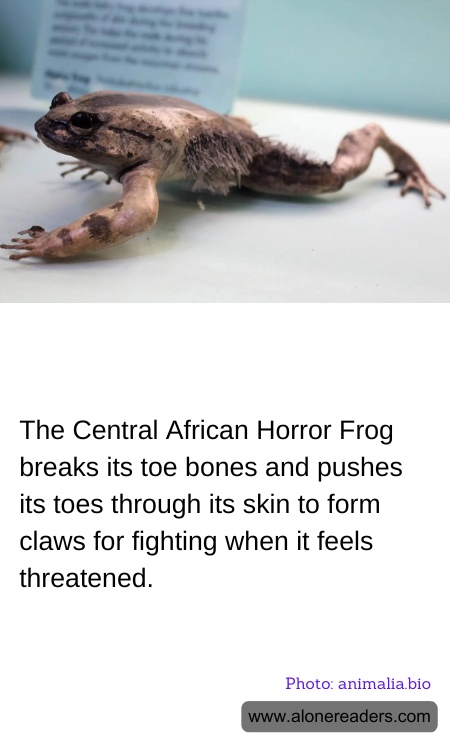
In the dense rainforests of Central Africa, a peculiar amphibian exhibits one of nature's most astonishing defense mechanisms. The Central African Horror Frog, scientifically known as Trichobatrachus robustus, has captivated biologists and nature enthusiasts alike with its unique ability to transform its own body into a formidable weapon. When threatened, this frog performs a remarkable feat: it breaks its own toe bones and pushes them through its skin to form sharp claws, a process that has earned it the nickname "Wolverine frog."
This extraordinary adaptation is a testament to the lengths to which nature will go to ensure survival. Unlike most frogs that rely on camouflage or toxic skin secretions to deter predators, the Horror Frog takes a more aggressive approach. When it senses danger, it contracts certain muscles, causing the bones in its toes to snap and pierce through the skin. These newly formed claws are not permanent; they retract back into the body once the threat has passed, and the skin heals over time. This ability to self-mutilate and heal is a rare phenomenon in the animal kingdom, making the Horror Frog a subject of great interest in evolutionary biology.
The discovery of this behavior has raised intriguing questions about the evolutionary pressures that led to such a drastic adaptation. It is believed that the frog's habitat, teeming with predators and competition, may have driven the development of this unique defense mechanism. The ability to wield bone claws provides the Horror Frog with a means to fend off attackers, giving it a fighting chance in the perilous environment of the African rainforest.
Beyond its defensive capabilities, the Horror Frog also plays a crucial role in its ecosystem. As both predator and prey, it helps maintain the delicate balance of its habitat. It feeds on insects and other small creatures, while also serving as a food source for larger animals. This dual role underscores the importance of preserving such unique species, as they contribute to the biodiversity and health of their ecosystems.
The Horror Frog's remarkable adaptation serves as a reminder of the incredible diversity and ingenuity of life on Earth. It challenges our understanding of what is possible in the natural world and highlights the complex interplay between organisms and their environments. As researchers continue to study this fascinating creature, it may offer insights into the mechanisms of evolution and adaptation, shedding light on the broader mysteries of life itself.
In a world where many species face the threat of extinction, the Central African Horror Frog stands as a symbol of resilience and the enduring power of nature. Its story is a testament to the wonders that still await discovery in the natural world, inspiring curiosity and awe in people of all ages.