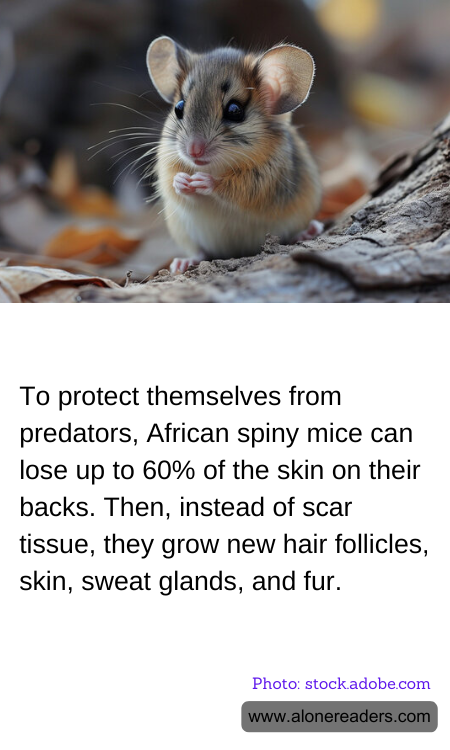
More About This Card
In the vast and diverse ecosystems of Africa, survival often hinges on the ability to adapt in extraordinary ways. Among the myriad of creatures that have evolved unique survival strategies, the African spiny mouse stands out with a remarkable defense mechanism that has intrigued scientists and nature enthusiasts alike. This small rodent, native to the arid regions of Africa, possesses an extraordinary ability to escape predators by shedding up to 60% of the skin on its back.
When faced with a threat, the African spiny mouse can detach large portions of its skin, allowing it to break free from the grasp of predators. This self-sacrificial act, while seemingly drastic, provides the mouse with a crucial opportunity to escape and survive. What makes this ability even more fascinating is the mouse's capacity for regeneration. Unlike most mammals, which heal wounds with scar tissue, the African spiny mouse regenerates its skin in a way that closely resembles the original tissue.
This regeneration process is nothing short of miraculous. After shedding its skin, the mouse begins to regrow not just the skin itself, but also the underlying structures such as hair follicles, sweat glands, and fur. This means that the new skin is virtually indistinguishable from the original, both in appearance and function. The ability to regenerate skin without scarring is a rare trait among mammals and offers valuable insights into the field of regenerative medicine.
The African spiny mouse's unique adaptation has sparked significant interest among scientists, who are eager to understand the underlying mechanisms that enable such efficient regeneration. Research into this phenomenon could potentially lead to breakthroughs in medical treatments for humans, particularly in the areas of wound healing and tissue regeneration. By studying the genetic and cellular processes involved in the mouse's skin regeneration, scientists hope to uncover new strategies for promoting similar healing processes in humans.
Beyond its scientific implications, the African spiny mouse's ability to regenerate its skin serves as a testament to the incredible diversity and adaptability of life on Earth. It highlights the intricate ways in which animals have evolved to survive in their environments, often developing capabilities that seem almost magical. For the African spiny mouse, this extraordinary trait not only ensures its survival but also positions it as a symbol of nature's ingenuity and resilience.
In conclusion, the African spiny mouse's ability to shed and regenerate its skin is a fascinating example of evolutionary adaptation. It underscores the complex interplay between survival and biology, offering a glimpse into the potential for scientific advancements inspired by nature. As researchers continue to explore this remarkable phenomenon, the African spiny mouse remains a captivating subject of study, reminding us of the wonders that exist within the natural world.