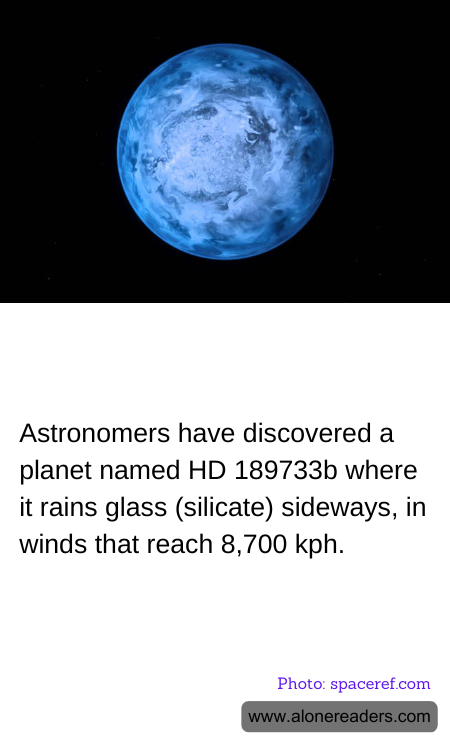
In the vast expanse of the universe, where the possibilities seem as endless as the stars themselves, astronomers have uncovered a celestial wonder that defies earthly imagination. The planet HD 189733b, located approximately 63 light-years away in the constellation of Vulpecula, presents a spectacle that is as mesmerizing as it is hostile. This distant world, a gas giant similar in size to Jupiter, has captured the attention of scientists and space enthusiasts alike due to its extraordinary weather phenomena.
HD 189733b is a planet where the skies are painted in hues of deep azure, but this serene appearance belies the violent conditions that rage beneath. The planet's atmosphere is composed of silicate particles, which, under the intense heat of its parent star, condense into tiny glass shards. These shards are then swept up by ferocious winds that howl across the planet at speeds reaching an astonishing 8,700 kilometers per hour. This creates a surreal and perilous environment where it literally rains glass sideways, a phenomenon that would be both beautiful and deadly to witness.
The discovery of such extreme weather conditions on HD 189733b offers a glimpse into the diverse and often inhospitable nature of exoplanets. The planet's close proximity to its star, a mere 4.7 million kilometers away, results in surface temperatures soaring to around 1,000 degrees Celsius. This intense heat is responsible for the vaporization of silicate materials, which then cool and solidify into glass as they are carried by the planet's powerful winds. The sideways rain of glass is a testament to the dynamic and volatile atmospheres that can exist beyond our solar system.
For astronomers, HD 189733b serves as a natural laboratory for studying the atmospheric dynamics of exoplanets. The planet's vivid blue color, reminiscent of Earth's oceans, is attributed to the scattering of light by silicate particles, offering insights into how light interacts with different atmospheric compositions. Observations of HD 189733b have been made possible through advanced telescopes and instruments, which continue to push the boundaries of our understanding of the universe.
While the conditions on HD 189733b are far from hospitable, the planet's discovery is a reminder of the incredible diversity of worlds that exist beyond our own. Each new finding challenges our perceptions and expands our knowledge of what is possible in the cosmos. As we continue to explore the universe, planets like HD 189733b inspire a sense of wonder and curiosity, inviting us to imagine the myriad forms that life and landscapes might take in the vastness of space.
